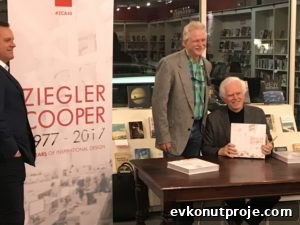
HOUSTON – (Realty News Report) – Decades before urban living became a popular choice, Scott Ziegler, AIA, Senior Principal of the Urban Residential Studio at Houston-based Ziegler Cooper Architects (ZCA), and his college roommate Michael Cooper were already committed urbanists. Four decades ago they founded the firm that still bears their names. Since then, Ziegler Cooper has master planned, designed, and delivered multifamily apartments, lofts, high-rise condominiums, and high-rise apartments totaling more than 18 million square feet. The firm also provides facility planning and design services for corporate clients and landlord representation for over 110 buildings with more than 42 million square feet of tenant space in the Houston area.
A Rice University graduate with a master’s degree in architecture and a bachelor’s degree in business administration from Trinity University, Ziegler has been an influential voice for sustainable urban growth and high-density mixed-use development. His new book, “Ziegler Cooper: 40 Years of Inspirational Design,” has been well received. Realty News Report spoke with Ziegler to explore how Houston’s density and design are evolving, and what lies ahead for both his firm and the city.
Realty News Report: Ziegler Cooper Architects began 40 years ago in Houston. What was your first project?
Scott Ziegler: As young architects, Michael Cooper and I wanted to design houses. We started Ziegler Cooper in 1977 while still at Rice. Our first paid commission was a solar home for a retired Air Force Major General on Lake Travis. Solar research resources were scarce then, but we completed the project while still students. We were heavily influenced by Rice classes in law and real estate, which taught us development fundamentals. We even convinced our fathers to co-sign on a land purchase so we could build three townhomes in Montrose. Land cost was about $2.25 per square foot and construction ran $16.50 per square foot — in 1977. While under construction a homeless person built a fire in an unfinished garage and all three townhomes burned. It was devastating, but it taught us invaluable lessons about thinking like developers: design, documentation, permitting, financing, construction, and marketing. That baptism by fire shaped our early career and prepared us to develop projects ourselves during our first years after architecture school.
Realty News Report: You concentrated on urban infill architecture. Why?
Scott Ziegler: We chose urban architecture because we wanted to create enduring buildings that enrich the character of the city. That meant moving away from wood-frame, low-cost, temporary structures and toward more permanent commercial construction. With guidance from a business consultant we focused on areas we were passionate about—buildings that address basic human needs: where people live, work, learn, and worship. Over time we developed deep expertise in those markets. Today the firm’s diverse portfolio includes projects that are integral parts of Houston’s urban fabric, which is personally and professionally rewarding.
Realty News Report: Twenty years ago urban living wasn’t as popular. What changed in Houston’s central business district?
Scott Ziegler: A major turning point came in the early 2000s with clients like Giorgio Borlenghi, for whom we designed Montebello and Villa d’Este—two elegant high-rise residential towers. Back then, cheaper land outside the Loop supported low-density housing. Now, with land inside Loop 610 often exceeding $100 per square foot, high-density development is the economic choice. The market has shifted toward high-rise rentals rather than condominiums because ownership costs inside the Loop are out of reach for many. Consequently we focus more on designing high-rise rental communities than condos.
Realty News Report: How have urban residential projects evolved?
Scott Ziegler: Developers and residents in Houston are more sophisticated about urban living. We analyze markets, demographics, and end-user needs to design for specific groups. One growing segment is empty nesters downsizing from single-family homes who prefer renting luxury apartments with amenities rather than buying. Five years ago they were unlikely to rent; today they often choose apartments that match or exceed condo quality. Millennial and younger professionals also value simpler lifestyles, less maintenance, and urban amenities like concierge services. Building design now reflects these lifestyle shifts: better finishes, smarter amenity packages, and more thoughtful urban integration.
Realty News Report: How does beautiful architecture enrich people’s lives in Houston? Can you give an example?
Scott Ziegler: I believe beauty has intrinsic value. Thoughtful, well-designed buildings enhance quality of life—whether workplaces, churches, schools, or residences—and become part of the city’s identity. One example is Hines’ Aris Market Square, a 32-story residential tower in the Theater District overlooking historic Market Square. Aris includes 274 luxury apartments, a 9,100-square-foot food hall called The Chef’s Hall, and a private pocket park designed to feel like a tree-shaded New Orleans courtyard. Hines insisted on a shared outdoor space between buildings that contributes to the public realm. Aris opened after Hurricane Harvey, has performed well, and earned a Landmark Award. It demonstrates how high-quality design and mixed uses can improve urban life.
Realty News Report: You mentioned densification. Tell us about Houston’s recent development patterns.
Scott Ziegler: For the last half-century Houston largely expanded outward to take advantage of cheaper land and lower construction costs, enabling many people to buy larger single-family homes. Now people—especially younger residents—prefer to live near cultural amenities, restaurants, transit, and workplaces. They want a shorter commute and a higher quality of life within what I call a 20-minute bubble: access to work, groceries, and entertainment within 20 minutes. Sprawl has serious long-term costs: infrastructure maintenance, environmental impacts, and increased flood risk from impervious surfaces. Houston’s current density is low compared to other major cities, which makes the city vulnerable and inefficient. For example, a high-rise like Aris provides housing for 300 units on less than one acre; 300 single-family suburban homes would require roughly 75 acres and many miles of roads. The 21st-century challenge is to reverse unsustainable low-density patterns and encourage higher-density, resource-efficient urban development.
Realty News Report: How do you create a distinctive sense of place for different demographic groups—Baby Boomers, Gen X, Millennials?
Scott Ziegler: Sensitivity to urban context is the starting point. Successful projects give back public space, improve streetscape, and provide walkable connections. Aris Market Square’s tree-lined streets, accessible pocket park, and ground-level food hall enhance the public realm. At The Woodlands’ East Shore, we helped Howard Hughes Corporation plan Hughes Landing, a waterfront mixed-use village that links town center amenities, office, retail, restaurants and a grocer into a walkable district. In Houston’s Regent Square (Sovereign phase) and other mixed-use projects, creating walkable neighborhoods with a balance of retail, office, and residential is essential. Different amenities respond to tenant profiles: secure bike storage and washing stations, pet care and grooming facilities, private dining rooms, rentable event spaces, and flexible social areas all cater to a mix of ages and lifestyles.
Realty News Report: What’s unique about Camden Downtown, which your firm recently started?
Scott Ziegler: Camden Property Trust’s 20-story, 275-unit tower at La Branch and Bell is their first ground-up high-rise in Houston. Located next to the Toyota Center and near major downtown attractions and transit, the tower uses a point-tower typology: a smaller tower footprint set on a podium wrapped with liner units to maintain a pedestrian-friendly street scale. Upper floors are set back to reduce shadows and let more light reach the street. Point towers allow high density while preserving urban livability—a typology I first observed in Vancouver and that works well in Houston.
Realty News Report: Downtown residential development moved from conversions like the Rice Hotel to ground-up towers like Camden. How will downtown evolve?
Scott Ziegler: Inner-loop development will continue to densify as land costs rise—$100 to $150 per square foot is common. Vertical mixed-use projects help share land costs across uses. We’re working with Midway Cos. on Buffalo Heights, a 28-acre, 2 million-square-foot mixed-use project in Memorial Heights that includes office, retail, and residential above a major H-E-B grocery anchor. The trend toward mixed-use, walkable districts responds to changing lifestyles and helps create resilient neighborhoods. Amenities are evolving too: bike and pet facilities, outdoor cooking areas, private dining rooms, and flexible community spaces reflect how residents live now. Developers and designers must keep anticipating market needs to remain relevant.
Realty News Report: What about the new Weingarten high-rise at River Oaks Shopping Center?
Scott Ziegler: The Driscoll is a significant mixed-use move for Weingarten, who partnered with Hanover for the project. They are replacing about 18,000 square feet of retail with a 30-story residential point tower in an exceptionally walkable neighborhood near restaurants, grocery, and shops. The project includes below-grade parking and aims to restore or increase parking overall. It reflects the broader trend of retail owners expanding into mixed-use development to capitalize on urban demand.
Coming soon: Part Two of Realty News Report’s Q&A with Scott Ziegler: The Next Phase of Houston’s Urban Densification.