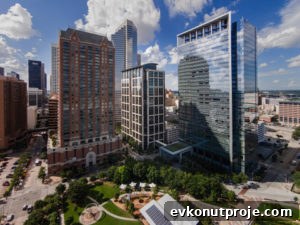
HOUSTON – Investment sales in Houston surged at midyear, climbing roughly 300 percent and pushing the city to fourth place nationally for investment sales, according to a new study from Avison Young.
Last year’s downturn, driven by low oil prices, left uncertainty about whether Houston had reached a firm bottom and caused many investors to hold back. But oil prices stabilized in the $40–$50 per barrel range and layoffs eased. As a result, more than $1 billion in real estate transactions closed in Houston during the first half of 2017, a marked increase reported in Avison Young’s Fall 2017 North America & European Commercial Real Estate Investment Review.
“With a brighter economic outlook, investor interest has returned and Houston looks poised to rebound in 2017 thanks to historic investment volume,” Avison Young said. “The recent flooding from Hurricane Harvey has not diminished investor interest in the city; many large deals remain underway.”
The Avison Young report reviewed 54 metropolitan markets across the U.S. and Canada, including Houston, Dallas and San Antonio in Texas.
“The largest increase in U.S. investment sales occurred in San Francisco, which posted a 73% gain versus the same period in 2016,” the firm noted. “Among major markets, Orlando, Boston and Houston also recorded impressive growth rates of 61%, 52% and 40%, respectively.”
The report highlights that sellers of commercial real estate continue to attract a diverse pool of buyers deploying abundant capital across asset classes and regions. In markets where product is scarce, pricing has peaked for some property types, prompting investors to seek opportunities farther afield and to accept higher risk in pursuit of returns.
Major transactions helped drive momentum. In April, Parkway Inc. sold a 49% interest in Greenway Plaza and Phoenix Tower for $512 million. That transaction boosted the office sector and encouraged other owners to market trophy properties. In June, Canadian investors announced a $1.2 billion acquisition of Parkway, a significant deal given Parkway’s 8.7 million-square-foot Houston portfolio comprised exclusively of office buildings.
Also this year, the Houston Center complex—a 4.2 million-square-foot downtown office campus—came to market. Brookfield agreed to buy Houston Center from J.P. Morgan Asset Management for $875 million in a transaction expected to close later in the year.
San Francisco-based Spear Street Capital made a notable entrance into Houston, acquiring several properties including 5 Houston Center in downtown, the Exxon Upstream Research campus on Buffalo Speedway, 515 Post Oak Boulevard, and Energy Center I near Interstate 10 and Dairy Ashford.
Avison Young also emphasized Houston’s industrial sector strength. The industrial market has benefited from sustained population growth, shifts tied to e-commerce, robust trade at the Port of Houston and ongoing expansion in the petrochemical industry.
“Industrial was Houston’s best-performing asset class through the downturn,” the report said. “Investment volume for industrial was up 126% in the first half of 2017 versus the first half of 2016. Multifamily remained a leading sector as well, recording nearly $2 billion in sales through mid-2017.”
“Retail investment totaled $693 million in the first half of the year,” the study added.
“Houston has solidified its role as a gateway city due to its global standing as the center of the world’s energy industry. Renewed investment activity shows Houston remains attractive to international capital, much like other U.S. gateway markets. Investors often cite the market’s diversification and an awareness of Houston’s cyclical nature as reasons for committing capital here.”
The report also highlighted activity in other Texas markets. In Dallas-Fort Worth, both domestic and foreign investors have taken notice of rapid growth. Above-average office leasing, development and investment over the past three years has reinforced D/FW’s reputation as a stable, globally recognized market. Low living costs and a business-friendly environment continue to draw large corporations, fueling employment gains and population growth.
San Antonio began 2017 on a positive trajectory as consumer confidence rose and the energy sector recovered. Avison Young described the city as a healthy secondary market that appeals to investors and developers priced out of primary markets. The IH-35 corridor between Austin and San Antonio continues to experience strong growth and urbanization, and San Antonio offers competitively priced options for businesses and residents compared with Austin’s averages.