HOUSTON – By Dale King – Investors are seeing substantial returns from creative office projects, according to a report from Transwestern, the global real estate firm headquartered in Houston. Creative office developments—typically conversions of industrial or retail properties into offices—have attracted major institutional buyers and prominent owner-users, driving sales at core and core-plus pricing across the country.
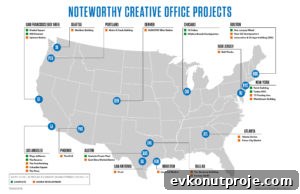
The study reviewed 30 developments nationwide, 10 completed and 20 in progress, including six projects in Texas. One notable example is Imperial Market in Sugar Land, the redevelopment of the former Imperial Sugar Refinery into a mixed-use destination featuring retail, creative office space, residential units and a hotel.
“Converting properties from industrial or retail uses into creative offices has become an increasingly popular value-add strategy for investors,” said Michael Soto, Transwestern’s director of research for Southern California and co-author of the report. While adaptive reuse is not new, Soto noted that what sets the current cycle apart is the volume and scale of exits achieved in recent years.
Transwestern identifies two trends driving demand for creative office space. First, technology, advertising, media and other companies seeking to attract younger talent prefer the characteristics of creative offices—open floor plans, abundant natural light, shared common areas and amenities such as cafés and recreational spaces. Second, tenants are returning to urban cores to benefit from live-work-play environments and proximity to cultural and dining options.
The report also cautions that many projects were acquired and designed under different economic conditions than those that exist now. “Rising land values and construction costs, particularly in desirable neighborhoods, increase project risk relative to a few years ago,” said Sandy McDonald, Transwestern’s director of research in Chicago and co-author of the study. “Adaptive reuse can also hide unexpected expenses and may require costly future modifications.”
The Transwestern analysis spans projects from Dallas to San Francisco, Los Angeles to Boston, New York to San Antonio, illustrating how adaptive reuse has reshaped commercial real estate across diverse markets.
Imperial Market: In 2015, the Texas Real Estate Fund announced plans to redevelop the historic Imperial Sugar Refinery site in Sugar Land, a Houston suburb. Founded in 1843 and closed in 2003, the refinery is being reborn as a mixed-use destination that preserves historic structures while creating economic activity and new jobs for the region.
Expected to open in mid-2018, Imperial Market is a $200 million project encompassing 850,000 square feet across 26 acres along U.S. Highway 90. It will be the centerpiece of Imperial, a 720-acre master-planned community developed by Imperial Market, LLC (Geoffrey Jones and James Murnane) and Johnson Development Corp., the lead residential developer. The community will eventually include nearly 2,000 homes, with custom and luxury builders offering homes that top out at $2 million.
Imperial Market’s program calls for 258,000 square feet of upscale retail and restaurants, 100,000 square feet of Class A office space and a 274-unit apartment complex. The 91-year-old, eight-story Char House on the site will be converted into a 185-room boutique hotel, while the historic refinery buildings along Oyster Creek will be preserved and restored.
Other significant adaptive reuse projects in Texas highlighted in the report include:
Seaholm Power Plant, Austin — A $124 million redevelopment that transformed a decommissioned power plant into a vibrant mixed-use destination. The project delivers 152,834 square feet of office space and 56,342 square feet of retail and restaurant space. The low-rise power plant building was repositioned as creative office space and is fully leased to AthenaHealth. A new residential high-rise with ground-floor retail (including Trader Joe’s and Under Armour) complements the site’s central business district location, high walkability and surrounding development.
Saint Elmo Market District, South Austin — A former school bus warehouse and one-time office furniture store is being renovated into a mixed-use district with roughly 100,000 square feet of creative office space, a 40,000-square-foot food hall, hotel rooms, apartments, retail and live music venues. Developer Maker Bros. (formerly Ground Flood Development) projected Phase I completion in mid-2018, with subsequent phases adding hotel and office space.
The Brewery Building, Dallas — A former brewery is being converted into creative office space with an adjacent high-rise apartment tower. Provident Realty Advisors is leading the approximately 180,000-square-foot redevelopment.
Factory Six03, Dallas — Granite Properties is redeveloping the former Brown Cracker & Candy Co./Sunshine Biscuit factory and West End Marketplace into 215,440 square feet of creative office space. The project includes a 25,000-square-foot lease to Blue Cross Blue Shield Innovation.
The Pearl, San Antonio — A transformation of the Pearl/Broadway District into a million-square-foot mixed-use neighborhood led by Silver Ventures. The Pearl has become one of San Antonio’s premier destinations for dining, local retail brands, a coffee shop, bakery and food hall. It hosts weekend farmers markets and frequent cultural and culinary events. The district offers contemporary urban apartments at The Can Plant, upscale residences at The Cellars, and Hotel Emma, a boutique property that opened in November 2015 in the repurposed Brewhouse originally built in 1894. Hotel Emma features a library, cocktail bar, upscale restaurant, small market and 146 rooms with luxury suites and generous public spaces. The success of the Pearl has encouraged additional adaptive reuse projects nearby, including renewed interest in redeveloping the historic Lone Star Brewery.
Adaptive reuse and creative office conversions continue to attract investor interest and reshape urban neighborhoods. While these projects bring cultural, economic and employment benefits, developers and investors must weigh rising construction and land costs, potential hidden expenses and the long-term implications of converting historic or industrial buildings to modern office and mixed-use purposes.
April 11, 2017 Realty News Report Copyright 2017