
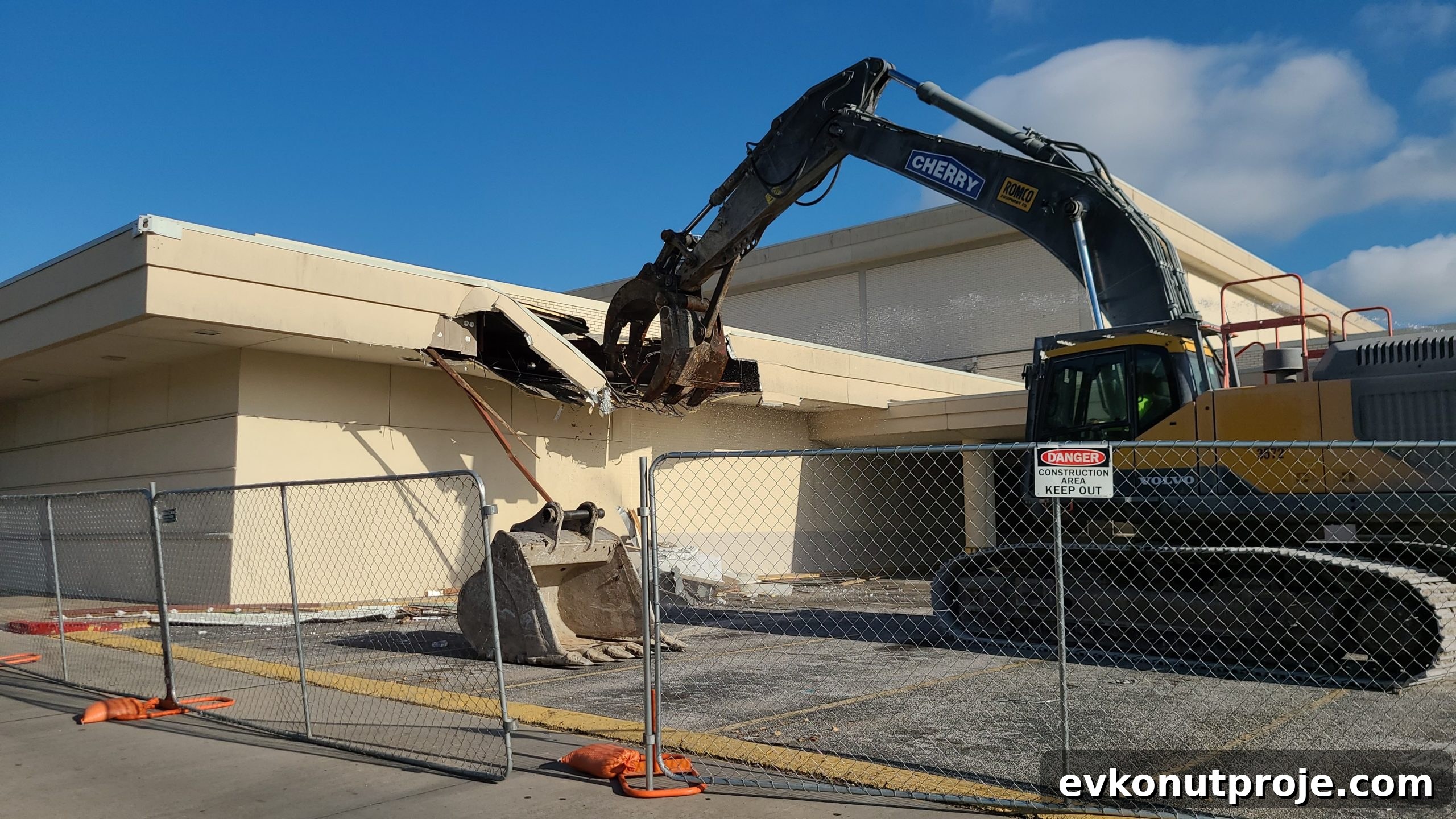
HOUSTON – (Realty News Report) – The Sears store at Memorial City Mall was demolished Tuesday, marking a local example of a nationwide shift as older mall anchors make way for modern redevelopment.
Sears was the original anchor at Memorial City Mall, opening in 1966 at the West Houston shopping center along the Katy Freeway.
The Memorial City Sears closed in late 2018 as part of the decline of a once-dominant retailer that operated more than 1,000 stores and maintained a prominent headquarters in Chicago. Sears Holdings filed for Chapter 11 in 2018 and today operates fewer than 100 stores.
As an excavator removed the building, the owner of the 1.7 million-square-foot retail complex said in a press release that it looks forward to redeveloping Memorial City.
“Today is an exciting day for us, as the demolition of Sears is the first visible step to creating a new chapter for Memorial City and further evidence that our company is well-positioned today and for the future,” said Jason Johnson, president of MetroNational, the Houston-based real estate investment, development and management firm that owns and operates Memorial City.
MetroNational is one of many companies repositioning aging shopping centers. Across the country, enclosed regional malls that once relied on anchors such as Sears, J.C. Penney and Macy’s or Dillard’s are reinventing themselves for a changing retail landscape.
Retail Transformation Underway
Retailers and property owners are exploring new uses for vacant anchor space. Reports have noted discussions between Amazon and mall owners about repurposing large anchor footprints for fulfillment or other logistics and service uses.
As legacy retailers such as J.C. Penney and Sears closed locations, vacancy grew in many malls. The COVID-19 pandemic worsened that trend, forcing many inline stores and mall restaurants to close and accelerating the shift away from traditional retail formats.
E-commerce and brick-and-mortar retail have been competing for years; the pandemic intensified that competition and sped up the changes already taking place in the industry.
Where older, 1960s-era retail properties are declining, however, planners and developers see opportunity. Many of these sites are well-situated in suburbs, town centers and urban neighborhoods, making them attractive for new mixed-use projects.
Examples of adaptive reuse include the redevelopment of a freestanding, 1939 art-deco Sears in Midtown Houston into The Ion innovation hub.
At Memorial City, removing the old Sears structure frees a 20-acre parcel that MetroNational envisions as “a visionary outdoor lifestyle and retail district.” The parcel is a key element of a long-term master plan for the 300-acre Memorial City campus, which calls for reimagining and redesigning the area to introduce new mixed-use and lifestyle options and improve walkability.
Fort Worth-based Trademark Property Company has been collaborating with MetroNational on the Memorial City redevelopment. Design firms Gensler and Stantec are leading the project’s design work.
Trademark Property Company’s portfolio includes work on Rice Village and other lifestyle destinations, Market Street – The Woodlands, South Victory and Galleria Dallas in the Dallas region, WestBend and Waterside in Fort Worth, La Palmera in Corpus Christi, Annapolis Towne Centre in Maryland, First Street Napa in California, and Saddle Creek in Tennessee.
Memorial City is a large mixed-use complex totaling nearly 10 million square feet. The campus includes Class A office space, retail, residential units, the Westin Memorial City and Hotel ZaZa Memorial City, and the Memorial Hermann Memorial City Medical Center.
Historical note: Sears, Roebuck and Co. was founded in Chicago in 1893 by Richard Warren Sears and Alvah Curtis Roebuck.
Aug. 12, 2020 Realty News Report. Copyright 2020.
Photo: Via MetroNational
File: Sears Demolished in Memorial City