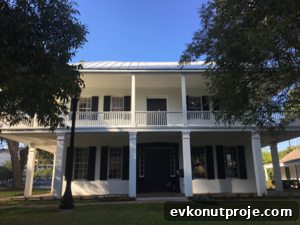
HOUSTON – (By Cynthia Lescalleet for Realty News Report) – After a $1.8 million stabilization and preservation effort, Houston’s oldest residence is reopening to the public following five years of closure.
Sited in Sam Houston Park on the west side of downtown, the Kellum-Noble House, built around 1847, remains on its original lot.
Extensive work on the foundation, roof and other structural elements has greatly improved the house’s stability.
Two completed phases of an overall three-phase restoration have also improved drainage, insulation, air conditioning and energy efficiency, and have enhanced conditions for the property that sits just steps from modern skyscrapers and freeway ramps.
According to materials from The Heritage Society at Sam Houston Park, structural upgrades not only stabilized the original foundation but also reinforced the rafters to guard against high winds from severe storms and hurricanes. The Heritage Society (THS) stewards a collection of 10 historic homes, dating from 1823 to 1915, which it has preserved in the 19-acre city park. The nonprofit rescued the then-deteriorating Kellum-Noble House from demolition after the society’s founding in 1954.
Repairing Cracks and Replacing Noisy Window Units
The recently completed exterior work addressed load-bearing masonry that had developed widening stress cracks, repaired windows and wooden porch framing and ceilings, and improved accessibility. Interior work included plaster repairs, electrical rerouting and repainting, guided by traces of original colors found on bricks behind sections of wall.
A future phase of restoration, estimated at $650,000 and originally planned for 2020, will focus on the porch columns. THS previously recreated columns using details from the Historic American Building Survey when original specifications were unavailable; the upcoming replacements will follow an 1890s photograph of the house.
Artifacts unearthed during foundation excavation are on display inside the home. The Kellum-Noble House will resume public tours (first floor only) beginning Thanksgiving week.
THS reports that the project was financed through private donations and public grants. The house is listed on the National Register of Historic Places, is designated a City of Houston Protected Landmark, and is a Recorded Texas Historic Landmark.
Minnette Boesel, interim president of THS, said the project posed significant challenges due to its scale, the impacts of Hurricane Harvey and rising costs. “We are grateful to our donors for their generosity and proud to have completed Phase 2 of three,” she said.
The Kellum-Noble House is now open for tours, and the first floor is available for special events.
The project team included Stern and Bucek Architects, Thomsen Co. general construction, Sparks Engineering Inc., Texas Turf Management (landscape design) and Texas Mulch Masters.
A Window into Houston’s Early History
This house is the one Houston home that has never been moved; the city grew up around it, said Ginger Berni, THS collections curator. Because it has remained on its original site, the property tells multiple strands of local history. It has withstood the city’s early industrial era, downtown commercial expansion, park development, later roadway construction and local preservation efforts.
The original eight-acre parcel once belonged to city founders John Kirby and Augustus Allen, then passed through several owners before coming into the hands of Nathaniel Kellum. Kellum ran a brickyard that used mud from the banks of nearby Buffalo Bayou, and his two-story home was constructed from those bricks. The restoration work revealed how far the original walls extend into the ground, Berni noted.
Over the years the property has served many roles: a school, a park, a small zoo (complete with a bear cub), offices for the city’s parks and recreation department, and the initial base for The Heritage Society before the organization relocated its operations to a museum elsewhere in the park.
“The reopening of the Kellum-Noble House is an important moment not only for the house itself but for the city,” Boesel said. “As Houston’s oldest surviving residence, the house teaches us about the people who lived here, how the building was used, and how physical changes over time reflect our city’s growth.”
Nov. 18, 2019 Realty News Report Copyright 2019
Read the New Book by Ralph Bivins, Editor of Realty News Report
Houston 2020: America’s Boom Town – An Extreme Close Up
Available on Amazon