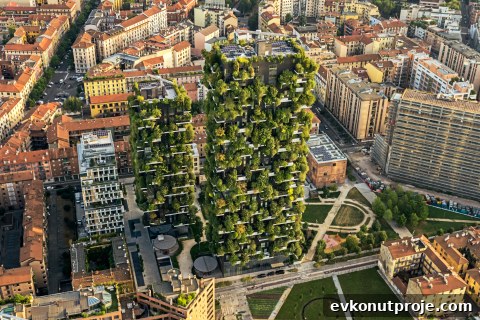
Urban Forestry: Stefano Boeri’s Vision for Greener, Resilient Cities
MILAN – (Realty News Report) — Architect and urbanist Stefano Boeri, founder of Stefano Boeri Architetti in Milan, has set out a compelling vision for Urban Forestry that integrates trees and green systems into the fabric of cities. His proposals emphasize planted roofs and green walls as essential features of sustainable urban design. In advance of Earth Day 2021, Realty News Report shares this statement from Boeri.
“We have entered a new phase of human history, in which we will finally see a new alliance between forests and cities. Historically we have separated the highly artificial urban realm from the natural realm of forests. Yet trees and woods must no longer be treated as mere decoration or confined to protected enclaves; they need to become an integral part of everyday life for millions of citizens across the globe. Defending existing forests, expanding tree cover within cities, and developing new ‘Forest-Cities’ are urgent priorities. If we want to halt climate change, these challenges must be addressed together and immediately,” states Stefano Boeri, the architect behind Milan’s internationally recognized Vertical Forest and a leading advocate for Urban Forestry worldwide.
Boeri has participated in numerous international initiatives, from the Urban Forestry strategy in Milan to the Great Green Wall of Cities presented at the United Nations Climate Action Summit. That initiative seeks to create 500,000 hectares of new urban forests and 300,000 hectares of adjacent natural forests near roughly 90 cities spanning from Africa to Central Asia, to be established and managed by 2030.
Climate change is intensifying hazards faced by city regions — droughts, heat waves, strong winds, floods and landslides — impacting hundreds of millions of people. Nature-Based Solutions and Forest-Based Solutions help cities adapt by cooling urban environments, stabilizing soils, protecting river basins and supplying essential resources to city dwellers. When coupled with appropriate technological innovation and locally adapted planning, such strategies strengthen climate resilience and deliver lasting social, environmental and economic benefits.
Given that cities account for roughly 70% of global CO2 emissions while forests absorb about 40% of atmospheric CO2, expanding woodland and urban tree cover both within and around cities can significantly boost urban resilience and reduce net emissions through photosynthesis.
Under the Urban Forestry framework, Boeri and his international team promote targeted design strategies such as planted roofs and vertical green walls. These measures represent ambitious, practical solutions for greening metropolitan areas, including arid and hot-climate cities.
Stefano Boeri Architetti’s research department leads debates on green and sustainable urban design across Europe and beyond. The firm’s work advances ecosystem-based urban regeneration through a nature-based approach, combining academic research and applied projects to create mixed-use developments that integrate biodiversity, water management and energy efficiency.
Addressing the most arid and torrid regions—places such as parts of Saudi Arabia and cities like Riyadh—poses particular challenges but also opportunities. The firm has developed methods and prototypes suited to extreme climates. For example, the Vertical Forest project planned for Cairo consists of towers approximately 30 meters tall and wide, each hosting around 350 trees and more than 14,000 shrubs and perennials representing 100 species—about one third of the genera found across Greater Cairo. With a total green surface exceeding 3,600 sq. m., the three new vertical forests—first of their kind in Africa—are designed to be energy self-sufficient, absorb roughly 7 tons of carbon dioxide per year and produce about 8 tons of oxygen annually.
Effective water management is fundamental to any successful urban greening effort, especially where green infrastructure is integrated into buildings and hard infrastructure. Optimized systems for collecting, storing, using and managing water resources are critical to meet climate goals. Stefano Boeri Architetti promotes several green systems tailored to water-scarce environments:
- Biodiversity-xerophilic green roofs that favor native, drought-adapted species and micro-habitat vegetation requiring minimal irrigation and low maintenance.
- Biodiverse vertical green walls that host a range of vegetation from trees to shrubs and perennials, supported by recycled greywater as a primary irrigation source.
- Bioactive green roofs and walls designed to assist greywater remediation, allowing plants to support final stages of water recycling within buildings.
- Planting schemes that emphasize functional and structural diversity—roughness complexity and eco-physiological variety to enhance water-cycle benefits, gas exchanges, and soil health.
These integrated systems create durable green infrastructure that mitigates the urban heat island effect, improves building insulation for facades and roofs, reduces stormwater runoff, and cuts air pollution. Living roofs and walls function as active components of urban environmental infrastructure rather than ornamental afterthoughts.
Choosing native plants for landscaping, roofs and walls also supports local wildlife and fosters healthier public spaces. Traditional lawns and heavily mulched suburban landscapes often depend on large amounts of synthetic fertilizers, pesticides and herbicides. In contrast, native-plant landscaping typically reduces chemical inputs and enhances ecological resilience, contributing to climate mitigation and biodiversity.
Nature-based solutions support sustainable urbanization, restore degraded ecosystems, improve adaptation and mitigation capacity, and bolster risk management and resilience. By reshaping the urban environment, these solutions can also improve inclusivity, equity and quality of life, regenerate deprived neighborhoods, and enhance mental and physical health. Better green infrastructure can strengthen social cohesion and reduce social tensions, particularly benefiting vulnerable groups such as children, the elderly and people with lower socio-economic status.
(Statement from Stefano Boeri Architetti of Milan.)
April 20, 2021 Realty News Report Copyright 2021
Rendering Credit: Stefano Boeri Architetti
For information on related real estate topics, see the book Houston 2020: America’s Boom Town – An Extreme Close Up by Ralph Bivins.
File: The Urban Forestry Solution for Sustainability
Earth Day Note: New timber office tower announced by Hines in Fort Lauderdale.