HOUSTON – (Realty News Report) – With lumber prices soaring, one might expect Hines to slow down construction of its mass-timber boutique office buildings. Not at all. The global developer is expanding its program of wood-framed, mid-rise offices even as material markets fluctuate.
Hines currently has two T3 (Timber, Transit and Technology) buildings under construction, two T3 projects completed, and roughly 20 additional timber projects in various stages of planning across North America and overseas. These modern timber buildings take design cues from redeveloped brick-and-timber warehouses—the converted lofts and creative office spaces that have become popular for their character and openness—but they combine that aesthetic with contemporary building systems and amenities.

Those old brick warehouses often feature interior wooden columns—essentially structural timber elements that recall whole tree trunks with smooth faces—but they can also come with functional compromises. Hines is addressing those shortcomings by designing new mass-timber buildings that provide the warm, textured look of exposed wood while delivering modern performance in safety, mechanical systems, accessibility and amenities.
“Tenants respond to that old-school feel—it evokes creativity, richness, and a sense of space and flexibility,” says Laura Hines-Pierce, Senior Managing Director – Office of the CEO at Hines and granddaughter of founder Gerald D. Hines. “But with these new buildings, they also get the technology, comfort and amenities of a brand-new development. That intersection—heritage character with modern performance—appeals to both tenants and investors.” Hines-Pierce discussed the company’s mass-timber strategy on CBRE’s Weekly Take podcast hosted by Spencer Levy.
The Weekly Take

During the conversation, host Spencer Levy asked about construction costs for timber projects. Steve Luthman, Senior Managing Director at Hines in Chicago, explained that the direct construction cost of a mass-timber building is typically slightly higher than a comparable concrete or steel structure—on the order of about 10 percent higher when comparing construction alone. But when other factors are considered, the overall economics change.
“Net, net, we believe mass-timber buildings are equivalent in cost,” Luthman said. He noted that recent steel price increases have narrowed that gap and in some cases made timber more economical than steel framing. Luthman also addressed media attention about rising lumber prices, pointing out that lumber commodity prices and the engineered mass-timber market are different: while some lumber categories surged during the pandemic, the underlying log prices for mass-timber feedstock have remained relatively stable.
Green Building
Environmental performance is another major reason developers and tenants are embracing mass timber. Replacing concrete and steel with responsibly sourced timber can significantly reduce embodied carbon. In the construction process alone, mass timber can generate around 50 percent lower CO2 emissions compared with concrete. Timber also delivers strong thermal performance and can contribute to energy efficiency in operation.
“In North America, we grow enough timber to construct one of these seven-story buildings every 20 minutes,” Luthman observed, emphasizing that the timber used in these projects typically comes from fast-growing, renewable sources that can be replanted. He stressed that properly managed harvesting for mass-timber production does not reduce overall forest volumes in North America and that these buildings represent one of the most environmentally sustainable typologies available today.
Major commercial real estate firms are also setting carbon-reduction targets. Emma Buckland, global president of Property Management at CBRE, described the company’s science-based goals: CBRE has committed to reducing its carbon emissions by 67 percent by 2035 and is transitioning its property-management fleets to electric vehicles where feasible as part of that effort.
The Next Timber Project
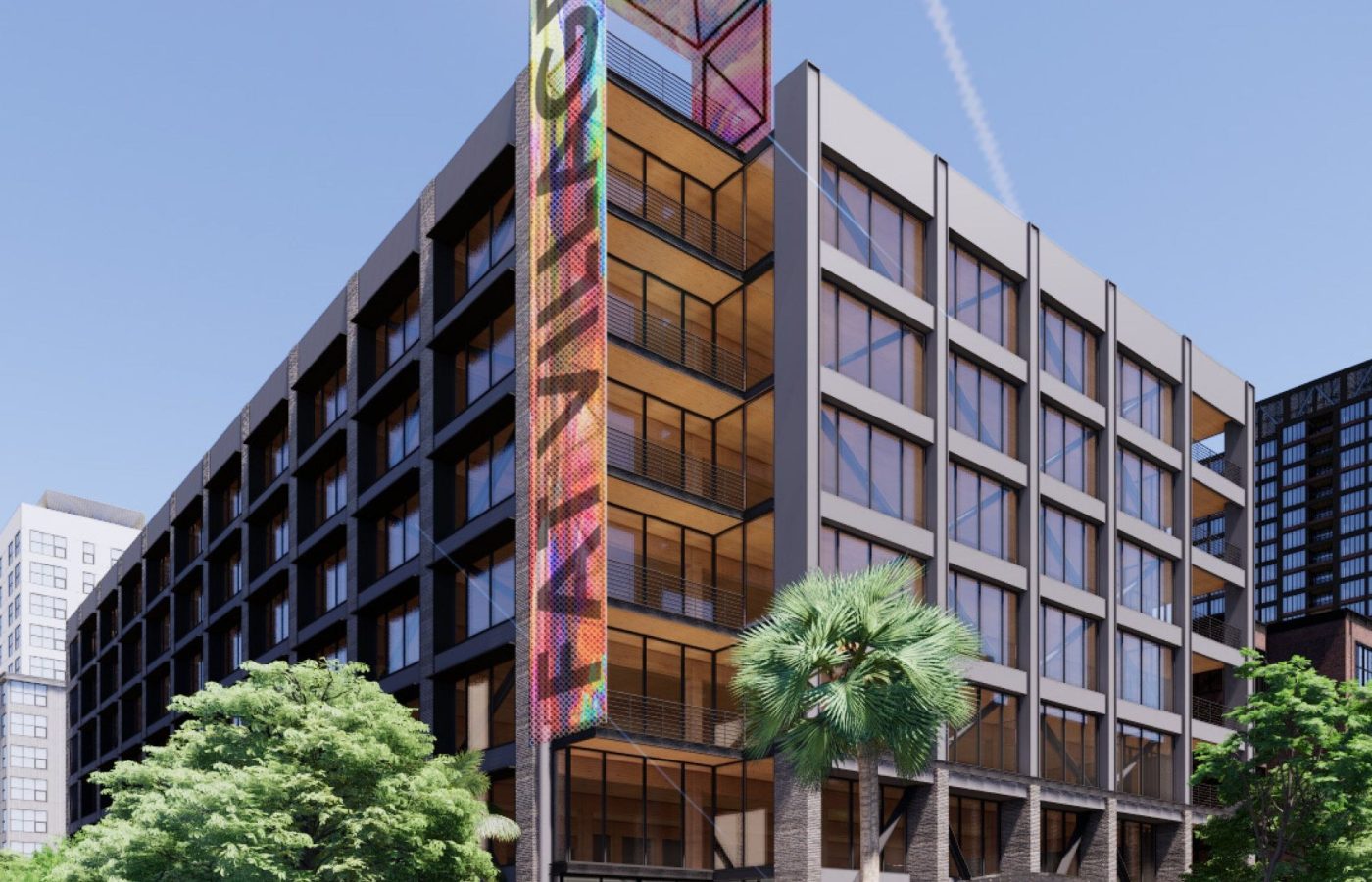
Hines has continued to expand its timber pipeline. A recently announced joint venture with Fort Lauderdale–based Urban Street Development will deliver a mass-timber office building as part of FAT (Food Art Technology) Village in Fort Lauderdale’s Flagler Village neighborhood. FAT Village is a 5.6-acre mixed-use creative district—comprising office, retail and residential space—designed to serve as a reimagined art-centric urban enclave along North Andrews Avenue. Hines’ T3 FAT Village project is planned as a roughly 180,000-square-foot office building and was expected to reach completion in 2024.
June 1, 2021 Realty News Report Copyright 2021
For more about Texas development, see the book Houston 2020: America’s Boom Town – An Extreme Close Up by Ralph Bivins. Available through common retail channels.
Images: Courtesy Hines, CBRE (Timber Buildings Grow Amid Carbon Concerns)
File: Hines – Timber Buildings Grow Amid Carbon Concerns.