Apartment Market Update: Rising Rents and Increasing Occupancy
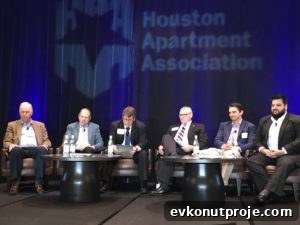
Houston Apartment Association panel: Stacy Hunt, Ric Campo, Patrick Jankowski, Bruce McClenny, Cyrus Bahrami, Manu Gupta. Photo credit: Ralph Bivins
HOUSTON – (Realty News Report) – Apartment rents in Houston are expected to rise in 2019 as strong job growth and steady homebuying trends support the multifamily market, according to a panel of industry leaders.
Bruce McClenny, president of ApartmentData.com, projects Houston’s multifamily occupancy will inch up to about 90 percent in 2019, up from 89.6 percent in 2018. He expects rent growth near 3 percent, roughly a $32 increase to an average monthly rent of $1,054 for a typical 882-square-foot apartment.
“I’m looking for two to three more years of steady growth,” McClenny said at the Houston Apartment Association’s State of the Industry breakfast at the Omni Hotel Galleria Houston.
Houston’s apartment market surged sharply after Hurricane Harvey made landfall on Aug. 25, 2017. In the immediate aftermath, many communities reached full occupancy as displaced residents sought temporary housing. Over time, as homes were repaired and residents returned, those occupancy spikes eased.
“I think 2019 is going to be better than 2018, but just slightly better,” said Ric Campo, CEO of Camden Property Trust, the Houston-based REIT that is building a $140 million, 20-story, 275-unit residential tower downtown adjacent to the Toyota Center.
Patrick Jankowski, senior vice president of research at the Greater Houston Partnership, said Houston is expected to add about 71,000 jobs in 2019. With low unemployment and a broadly healthy economy, Jankowski called the current conditions the best the region has seen since the 2014 fracking boom.
Oil prices have been hovering around $50 a barrel—approximately the break-even point for many energy operators—providing stability to the local economy. While production is rising, energy companies are operating more efficiently than in the past, which limits the potential for large-scale new hiring in the sector.
Jankowski warned that constant talk of an impending recession could become a self-fulfilling prophecy. “My biggest concern in Houston and in the U.S. is all this talk that we are overdue for a recession,” he said. “I do not see a recession in the works for Houston or for the U.S. Please, please, please stop talking about this.”
Campo noted that institutional investors remain attracted to Houston. “You don’t have any problem getting institutional capital in Houston today,” he said, reflecting continued investor confidence in the market.
Cyrus Bahrami, managing director in Houston for Alliance Residential of Phoenix, said Houston’s diversified economy makes the city appealing for additional multifamily investment. Alliance has several projects underway in the area, and more are expected to break ground soon.
“We have seven slated to start over the next year,” Bahrami said, signaling ongoing development activity.
Manu Gupta of Indus Management emphasized value-add opportunities in the market, noting that buying Class C properties and investing $5,000 to $15,000 per unit to renovate can yield attractive returns.
Demographic shifts are also shaping demand across Houston’s multifamily sector. Baby Boomers are increasingly returning to the central city, leaving suburban empty-nester life behind. They are drawn by cultural amenities, the arts and high-end dining, and often prefer well-amenitized rental communities inside the Inner Loop—contributing to urban densification and stronger demand for high-rise living.
Millennials continue to be a major driver of multifamily demand as well. Stacy Hunt, executive director of real estate services for Greystar, observed that many Millennials have been slower to purchase homes, delaying marriage and homeownership and therefore remaining in rental housing longer.