HOUSTON – (By Dale King, Realty News Report) – A new CBRE study confirms what industry observers have long suspected: Houston is a major force in the big-box warehouse and industrial logistics sector. The report highlights Houston’s appeal to both domestic institutional investors and international buyers, noting strong recent transaction activity and substantial new development.
CBRE reported annual industrial sales in Houston of $1.2 billion in 2018, $900 million in 2019 and $1.7 billion in 2020. Those figures underscore growing investor interest in the city’s logistics market, driven by rising e-commerce demand and an expanding distribution network.
Construction Boom
In 2020, Houston saw more than 12 million square feet of new warehouse space delivered, placing it among the nation’s heaviest warehouse construction markets. CBRE attributes this development surge to Houston’s pro-business environment, favorable real estate fundamentals and sustained population and employment growth, all of which support a thriving industrial market.

Peter Mainguy, senior managing partner at CBRE, points to Houston’s resilience through economic downturns, natural disasters and the pandemic as a key reason investors and occupiers continue to back the market. Recent demand for warehouse space has been driven primarily by e-commerce, third-party logistics providers and building supply companies seeking modern, large-format distribution centers.
The surge in new construction temporarily pushed vacancy higher: CBRE reported a direct vacancy rate of 7.4 percent in Houston. At the same time, overall industrial transaction volume reached 4.4 million square feet in 2020, a 6.8 percent increase year-over-year.
The CBRE study, titled “North American Industrial Big Box Report and Outlook,” finds that North America’s industrial and logistics sector posted historic strength in 2020. Despite broad economic disruption, occupiers accelerated moves into modern facilities to serve a rapidly growing online consumer base and to build inventory buffers against supply chain interruptions.
CBRE defines an industrial big-box property as a warehouse or distribution center of 200,000 square feet or larger. The report notes that a wide range of occupiers—retailers, logistics firms, manufacturers and wholesalers—expanded their presence in big-box facilities to be closer to consumers, to access expanding logistics hubs and to benefit from government incentives in some regions.
Houston’s central location is a decisive advantage. More than seven million people live within 50 miles of the city’s core, and that population base is projected to grow by 9.7 percent over the next five years. This concentration of population and freight activity reinforces Houston’s role as a distribution hub for the South-Central United States.
The Houston Workforce
Nearly 26 million people live within 250 miles of Houston, with an expected population increase of 7.9 percent in the coming years. The demographic profile is favorable for logistics employers: 35 percent of the local population falls in the 18–34 age bracket, an important cohort for warehouse and distribution labor.
CBRE Labor Analytics estimates Houston’s warehouse labor pool at about 92,437 workers, and forecasts a roughly 10 percent increase in that workforce over the next decade. Despite that growth, average wages for non-supervisory warehouse personnel in Houston remain about 3.4 percent below the national average, offering cost-competitive labor for occupiers.
The report emphasizes Houston’s deep distribution network. The Port of Houston is the largest container port on the U.S. Gulf Coast and has played a central role in expanding the city’s international trade footprint. Houston also hosts the nation’s largest petrochemical complex and the world’s second-largest, while major carrier routes and an active barge corridor on the Gulf Intracoastal Waterway further support freight movement.
Houston’s extensive highway system ties to its airports, seaports and mainline railroads, and the city sits at the intersection of Interstates 10, 45 and 69. I-69—frequently called the “NAFTA superhighway”—connects Canada, the U.S. industrial Midwest, Texas and Mexico, enhancing cross-border and national distribution efficiency.
Looking forward, Houston ranks fourth among the 22 North American markets CBRE analyzed for warehouse space currently under construction. Approximately 31.1 million square feet of industrial space is being developed in the market, with about 46.5 percent of that space already leased.
Dallas-Fort Worth, another Texas market analyzed by CBRE, sits slightly lower on the list but remains a powerful logistics hub. D-FW had about 11.1 million square feet under construction at the time of the report, with roughly 20 percent pre-leased. South New Jersey/East Pennsylvania, Chicago, Atlanta and Memphis top the list of markets with the most construction activity.
CBRE highlights D-FW’s strategic assets, including the Alliance Global Logistics Hub and the International Inland Port of Dallas, plus the convergence of three major rail networks—Union Pacific, BNSF and Kansas City Southern—providing rail reach to nearly the entire U.S. market within 48 hours. D-FW International Airport ranks among the nation’s largest cargo airports and can expand operations significantly without major footprint changes.
Investment incentives have also supported D-FW’s logistics growth: CBRE notes 73 economic incentive deals in the past five years totaling more than $606 million, an average of about $11,541 per new job according to regional data cited in the report. “D-FW continues to outperform expectations and possesses some of the healthiest industrial market fundamentals and sales activity in the U.S.,” said CBRE Vice Chairman Randy Baird.
CBRE’s review of 2020 sales activity also shows dramatic swings: U.S. industrial sales volume reached $1.1 billion in the first quarter of 2020—more than a 500 percent increase from Q1 2019—before the COVID-19 pandemic dramatically slowed transactions in Q2. Activity picked up again later in the year, with $658 million in sales in Q3 and $1.2 billion in Q4.
April 1, 2021 Realty News Report Copyright 2021
For further reading on Houston’s development, consider the book Houston 2020: America’s Boom Town – An Extreme Close Up by Ralph Bivins, which provides additional perspective on the city’s recent growth and transformation.
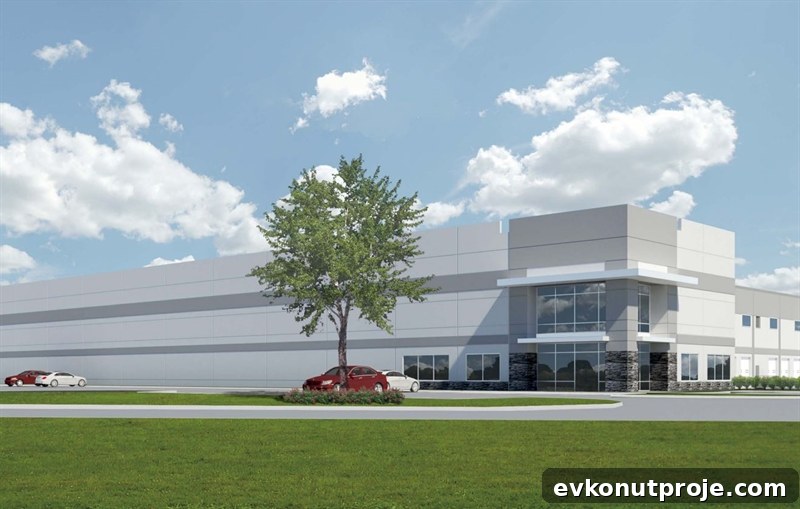
Image: Rendering of a new Houston project. Courtesy: Trammell Crow