SAN DIEGO – (By Ralph Bivins of Realty News Report) – After a dramatic surge that drove home prices up more than 30 percent in some cities in 2021, the nation’s housing market is expected to moderate next year, according to Lawrence Yun, chief economist of the National Association of Realtors.
“Next year is going to be essentially flat,” Yun told a large audience at the San Diego Convention Center on Friday during the association’s annual convention.
“All markets are seeing strong conditions and home sales are the best they have been in 15 years,” Yun said. “The housing sector’s success will continue, but I don’t expect next year’s performance to exceed this year’s.”
Extremely low for-sale inventory fueled a heated market over the past 18 months. Sellers frequently received multiple offers and buyers engaged in bidding wars, pushing prices to record highs.
Yun expects homebuilding to increase enough to ease the shortage somewhat. He also noted that the end of mortgage forbearance programs will likely force some homeowners to list their properties, which should raise inventory levels.
In addition, mortgage rates are forecast to rise in 2022. Without the availability of ultra-low rates around 3 percent, the frenzy among buyers is likely to normalize to some degree.
Yun forecasts 30-year fixed mortgage rates will average about 3.7 percent in 2022.
Key forecasts from NAR Chief Economist Lawrence Yun:
1. Home prices: Yun projects national home prices will increase roughly 2.8 percent in 2022, a slowdown from the projected 14.7 percent rise in 2021.
2. Home sales: The number of homes sold is expected to decline about 1.7 percent in 2022, following a projected 6.4 percent increase in 2021.
3. Commercial real estate: Office vacancy will continue to rise, leaving the office sector the most challenged. Yun expects the average national office vacancy to reach about 13.5 percent in 2022, up from a projected 12.2 percent in 2021. By contrast, the national multifamily vacancy rate is expected to fall in 2022.
The shift to remote work will have lasting effects across the economy. As employers reduce office footprints, office vacancy will increase. At the same time, work-from-home trends will influence homebuyers’ neighborhood and location choices for years to come.
Can inflation be a positive?
Inflation will shape real estate dynamics in 2022.
“Inflation is high and it could go higher,” Yun said.
Building material prices have surged, and shortages have emerged for lumber, paint and many other supplies. Builders are also experiencing acute shortages of windows, industry experts report. Mobile home prices, Yun noted, have risen about 25 percent.
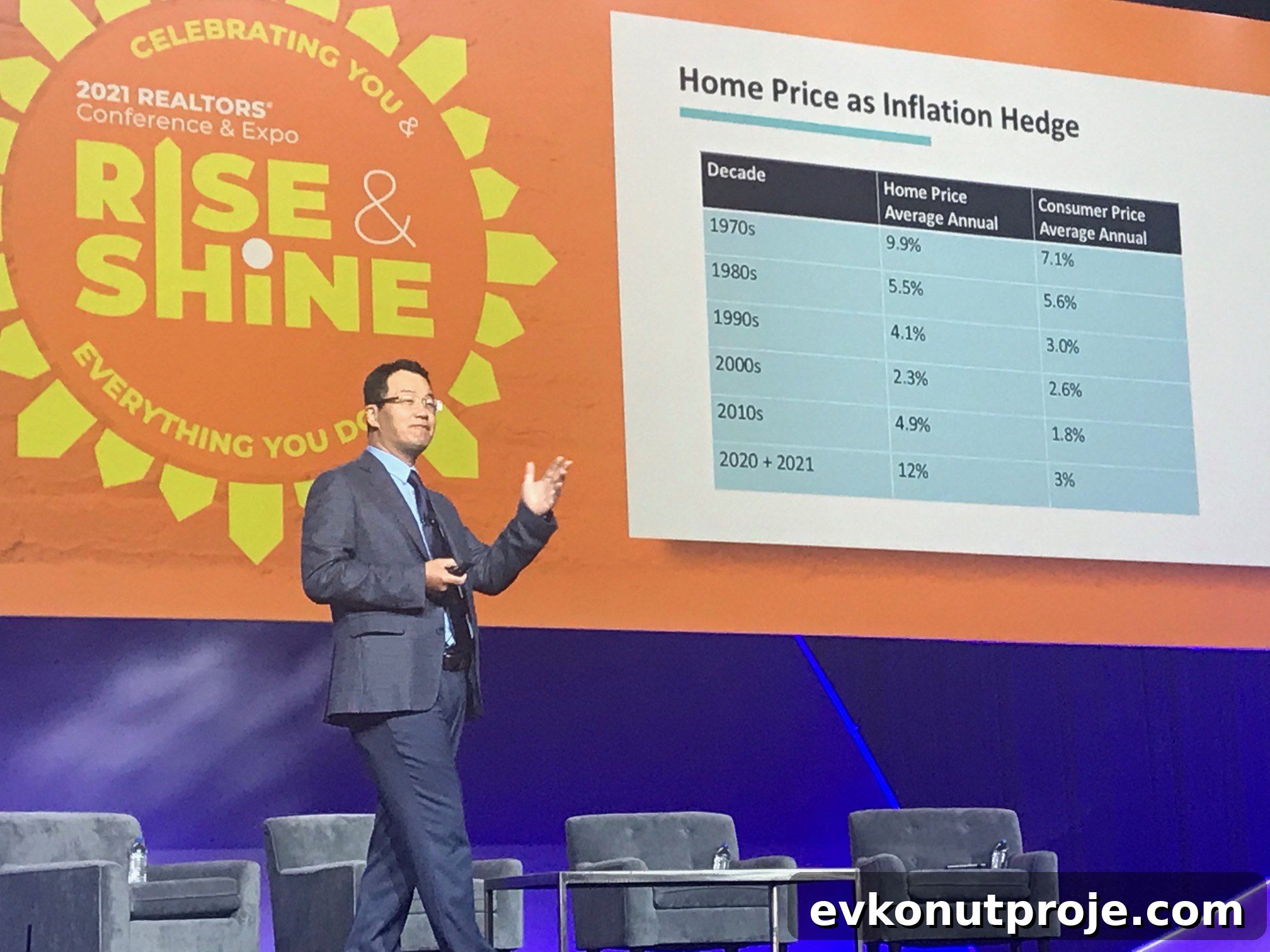
Despite these pressures, Yun highlighted a potential silver lining: real estate can serve as a hedge against inflation.
He pointed to the 1970s as an example: during a period when inflation ran near 7.1 percent annually, home prices increased on average about 9.9 percent, outpacing inflation.
For Realtors advising clients in 2022, emphasizing real estate’s role as an inflation hedge may help encourage buyers to act.
Nov. 15, 2021 Realty News Report Copyright 2021
Photo credit: Ralph Bivins, Realty News Report 2021
Caption: NAR Chief Economist Lawrence Yun addresses the National Association of Realtors convention in San Diego on Nov. 12, 2021.
For more about Texas real estate, see the book Houston 2020: America’s Boom Town – An Extreme Close Up by Ralph Bivins. Available on Amazon
Houston 2020 Ebook version
File: NAR 2022 Realty Forecast