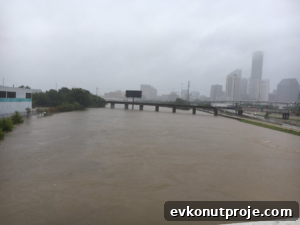
HOUSTON – (By Dale King, Realty News Report) – Hurricane Harvey dumped as much as 50 inches of rain, demonstrating the catastrophic potential of major storms. But speakers at a recent CoreLogic storm surge seminar emphasized that even a Category 1 hurricane can produce devastating storm surge flooding along the coast and far inland. These surge-driven floods pose a serious risk to homes in many coastal and near-coastal communities.
Dr. Tom Jeffery, senior hazard scientist at CoreLogic, described storm surge as one of the primary hazards associated with hurricanes. Webinar experts noted that storm surge produces walls of wind-driven water that strike coastal areas and can be pushed far inland through rivers, estuaries and other channels. Even a relatively weak hurricane on the Saffir–Simpson Hurricane Wind Scale can cause extensive inland flooding when storm surge is involved.
“Seventy percent of the homes damaged during Hurricane Harvey were not insured for floods,” Dr. Jeffery said during the seminar. Given that reality, panelists recommended that homeowners in hurricane-prone states consider purchasing flood insurance, even if their properties are not located in officially designated flood zones.
Experts explained that storm surge-driven flooding often occurs when surge waters force rivers, streams and drainage channels to overflow, sending water into interior neighborhoods and producing severe inland impacts.
According to CoreLogic, Florida has the largest number of homes developed along the coastline that lie within areas exposed to storm surge, and it also records the highest reconstruction cost value (RCV). Texas ranks fourth in homes at risk, behind Louisiana and the New York–New Jersey metropolitan region.
The 2019 hurricane season began quietly, and while a disturbance was noted along Mexico’s Gulf Coast, residents in parts of Florida prepared by stocking supplies and taking advantage of routine sales tax holiday weekends. Three days before the official start of the season, CoreLogic released its 2019 Storm Surge report, which cited early NOAA predictions that indicated a near-normal Atlantic and Gulf hurricane season for 2019.
NATIONAL HURRICANE CENTER REPORT — 2:00 AM EDT Tue Jun 4 2019 — Disorganized Gulf System Near Mexico. 50 Percent Chance of Formation into Tropical Cyclone.
Heavy rainfall is also likely to spread over
southeastern Texas and Louisiana through Thursday.  An Air Force
Reserve reconnaissance aircraft is scheduled to investigate the
disturbance later today, if necessary.  Interests along the Gulf
coast of Mexico should monitor the progress of this system.
Forecasters and analysts on the webinar urged caution about seasonal projections while stressing that it only takes one storm to cause major damage. “I tend to go with the NOAA reports. They are provided by the best of the best,” said Curtis McDonald, a CoreLogic meteorologist and senior product management professional. “Their forecasts are excellent, but it only takes one storm to make landfall. We don’t want to overreach our conclusions from seasonal estimates.”
McDonald pointed to Hurricane Michael in 2018 as an example: if its track had shifted only slightly, it would have affected many more homes. Webinar presenters focused on data and exposure modeling rather than on step-by-step preparedness. Their research indicates that more than 7.3 million single- and multifamily homes along the U.S. Gulf and Atlantic coasts face potential storm surge damage, with a combined reconstruction cost value approaching $1.8 trillion.
CoreLogic’s annual analysis quantifies the number of homes vulnerable to storm surge across the 19 coastal states from Texas to Maine, a span of roughly 3,700 miles. The study calculates RCV using combined costs for construction materials, equipment and labor, and it assesses risk across those 19 states and 85 Core-Based Statistical Areas (CBSAs).
This report marks the first year CoreLogic’s analysis includes multifamily structures—apartments, condominiums and other multi-unit housing—alongside single-family residences.
“It is essential to understand and evaluate the total hazard exposure of properties at risk of storm surge prior to a hurricane event, so insurers can better protect and restore property owners from financial catastrophe,” Dr. Jeffery said. He added that recent years have shown storm surge and inland flooding to be more destructive than wind alone, warning that the hurricane category does not fully reflect potential loss. A Category 5 storm in a lightly developed area may cause far less overall damage than a Category 1 storm striking a densely populated region.
The webinar highlighted several key regional, state and metro implications:
Regional Implications
-
The Atlantic Coast accounts for 57% of homes at risk from storm surge (about 4.1 million homes) and 62.7% of the total RCV (approximately $1.1 trillion).
-
The Gulf Coast accounts for 43% of homes at risk (about 3.1 million homes) and represents 37.3% of the total RCV (around $668 billion).
State Implications
-
Florida, Louisiana, New York and Texas have the largest numbers of homes at risk from storm surge.
-
Florida has the greatest exposure, with more than 2.9 million homes at risk and an estimated RCV exceeding $603 billion.
-
Louisiana holds the second-largest exposure. In New York, high residential density near the coast makes the region particularly vulnerable to flooding even though hurricanes are less frequent there.
-
Texas ranks fourth with more than 561,000 homes at risk and the fifth-highest RCV, about $113 billion.
Metro Implications
-
The New York–Newark–Jersey City metropolitan area faces the highest storm surge risk, with just over 831,000 homes at risk and an RCV exceeding $330 billion.
-
The Miami metropolitan area (including Miami, Fort Lauderdale and West Palm Beach) follows closely with more than 827,000 homes at risk and an RCV of about $166 billion.
-
Because large metropolitan areas concentrate residences near coasts, the top 15 CBSAs represent 67.5% of the total number of homes at risk and 68.9% of the total RCV for storm surge risk in the United States.