HOUSTON – (By Ralph Bivins, Realty News Report) – Can Space City make a comeback? Houston has the opportunity to reclaim the energetic, entrepreneurial spirit that once defined it, but doing so will require renewed purpose, clear leadership, and a focused economic strategy.
For years Houston has been proud to wear the Space City name, anchored by NASA’s Johnson Space Center in southeast Harris County. Yet the city has recently fallen short in high-profile economic contests — including failing to rank among the top 20 contenders in Amazon’s search for its HQ2 — and rivals such as Dallas and Austin have consistently outperformed Houston in attracting new investment.
Houston still has the assets and the heritage to lead. In 1961 NASA established the Manned Spacecraft Center on 1,700 acres outside the city, and Houston became synonymous with America’s human spaceflight efforts. Those early decades brought national attention: the city built the Astrodome — the world’s first domed, air-conditioned stadium — and the Texas Medical Center grew into a global healthcare hub. Innovations like Astroturf emerged from local problem-solving, and Mission Control became a symbol of American ambition.
That spirit resurfaced recently when NASA, partnering with SpaceX and its founder Elon Musk, returned human spaceflight capabilities to the United States. In 2020 astronauts Robert Behnken and Douglas Hurley launched aboard a SpaceX rocket from Cape Canaveral, marking the first U.S. crewed launch in nearly a decade. That success reopens opportunities for Houston to position itself at the center of a revived human spaceflight industry.
Visionary Leadership
The achievements of the 1960s were driven by a clear, ambitious vision. President John F. Kennedy’s 1962 speech at Rice Stadium set the nation’s course to put a man on the Moon by the end of the decade, and the country rallied to meet that challenge. Houston embraced that mission: NASA put a human on the Moon in 1969 and Mission Control became an international symbol of coordinated effort and technical excellence.
Vision outlasts any single leader. As the Book of Proverbs reminds us, “Where there is no vision, the people perish.” Today Houston must ask: What is our mission? What is the core identity that unites our bus drivers, nurses, educators, small business owners, and civic leaders?
A Call for Unified Leadership
Houston needs a leader who can articulate a bold, inclusive vision for the region and rally the city behind it. This leader should inspire collaboration across neighborhoods, industries, and political lines so the region’s economic growth benefits all residents. The city doesn’t need a caretaker who clings to the status quo; it needs a visionary who will take responsible risks and set clear goals for the next decade.
As 2030 approaches, Houston faces both promise and peril. The city is on track to become one of the nation’s largest metropolitan areas, and without coordinated leadership the region could miss critical opportunities or experience growing pains that weaken its competitiveness. Unity should come first: partisan labels and presidential endorsements should not dictate the path forward. Instead, Houston’s next leader should prioritize practical solutions and long-term prosperity for all communities.
To restore Houston’s momentum, leaders should build on existing strengths — NASA and the renewed human spaceflight program, the Texas Medical Center’s global reputation, and the city’s deep entrepreneurial base — while committing to inclusive economic development, workforce training, infrastructure investment, and a compelling civic identity that attracts talent and business.
Houston has done hard things before. It once built an unprecedented domed stadium and became the nation’s gateway to space exploration. That same resolve and ingenuity can guide the city again if leaders and residents embrace a shared vision, act decisively, and prioritize unity over division.
The words of President John F. Kennedy:
“There is no strife, no prejudice, no national conflict in outer space as yet. Its hazards are hostile to us all. Its conquest deserves the best of all mankind, and its opportunity for peaceful cooperation may never come again. But why, some say, the Moon? Why choose this as our goal? We choose to go to the Moon in this decade and do the other things, not because they are easy, but because they are hard.” – President John F. Kennedy at Rice Stadium in Houston, Sept. 12, 1962.
June 16, 2021 Realty News Report. Copyright 2021.
Commentary by Ralph Bivins, Editor of Realty News Report.
Photo credit: Ralph Bivins, Realty News Report. Copyright 2021.
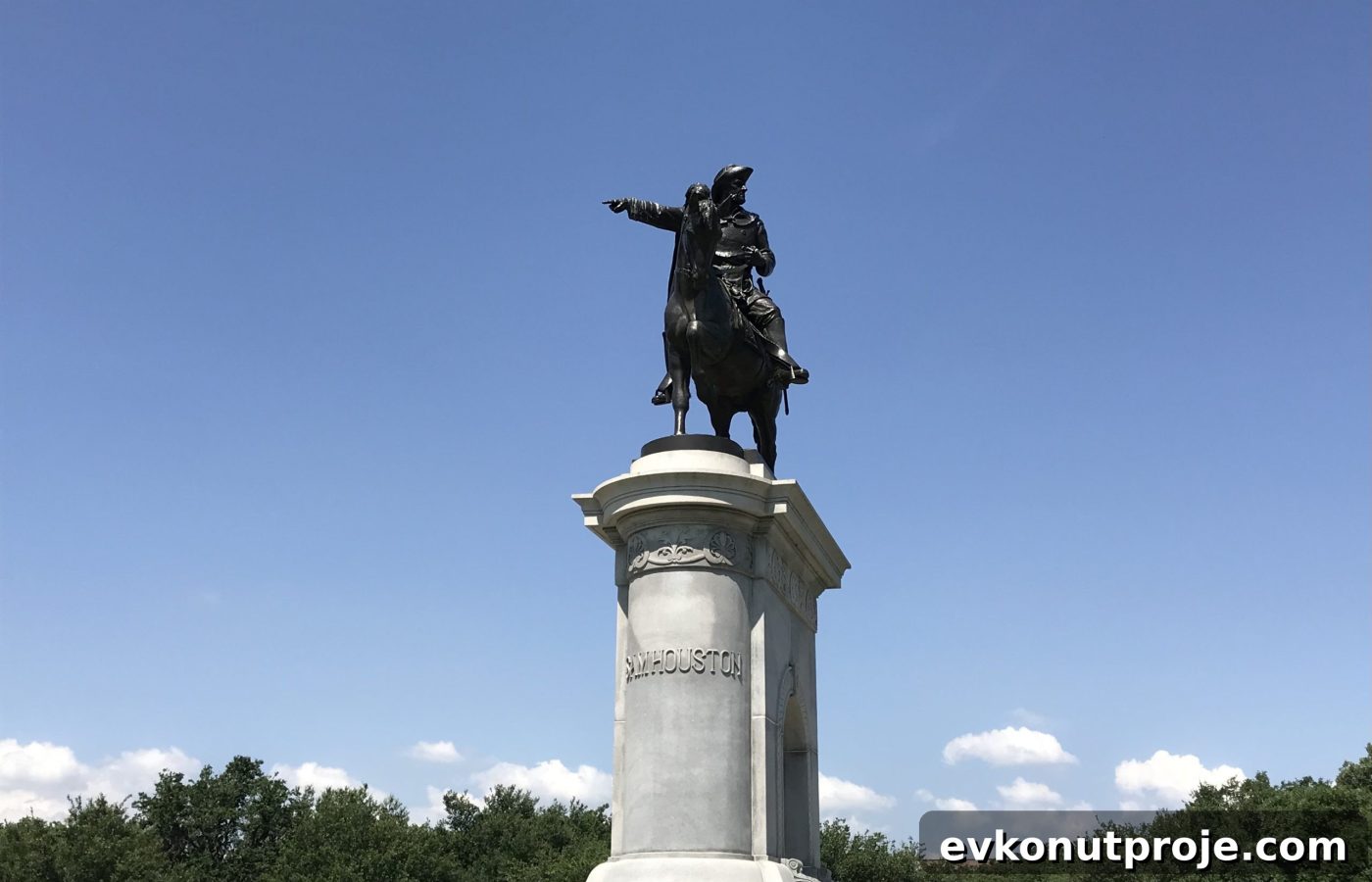
Caption: The Sam Houston Monument in Hermann Park. Sculpted by Enrico Filiberto Cerrachio and completed in 1924, the monument was commissioned by the Women’s Club of Houston. General Sam Houston was the first President of the Republic of Texas.
About the author’s book: Houston 2020: America’s Boom Town – An Extreme Close Up by Ralph Bivins is available in print and ebook formats.
File: Wherefore Art Thou Houston?