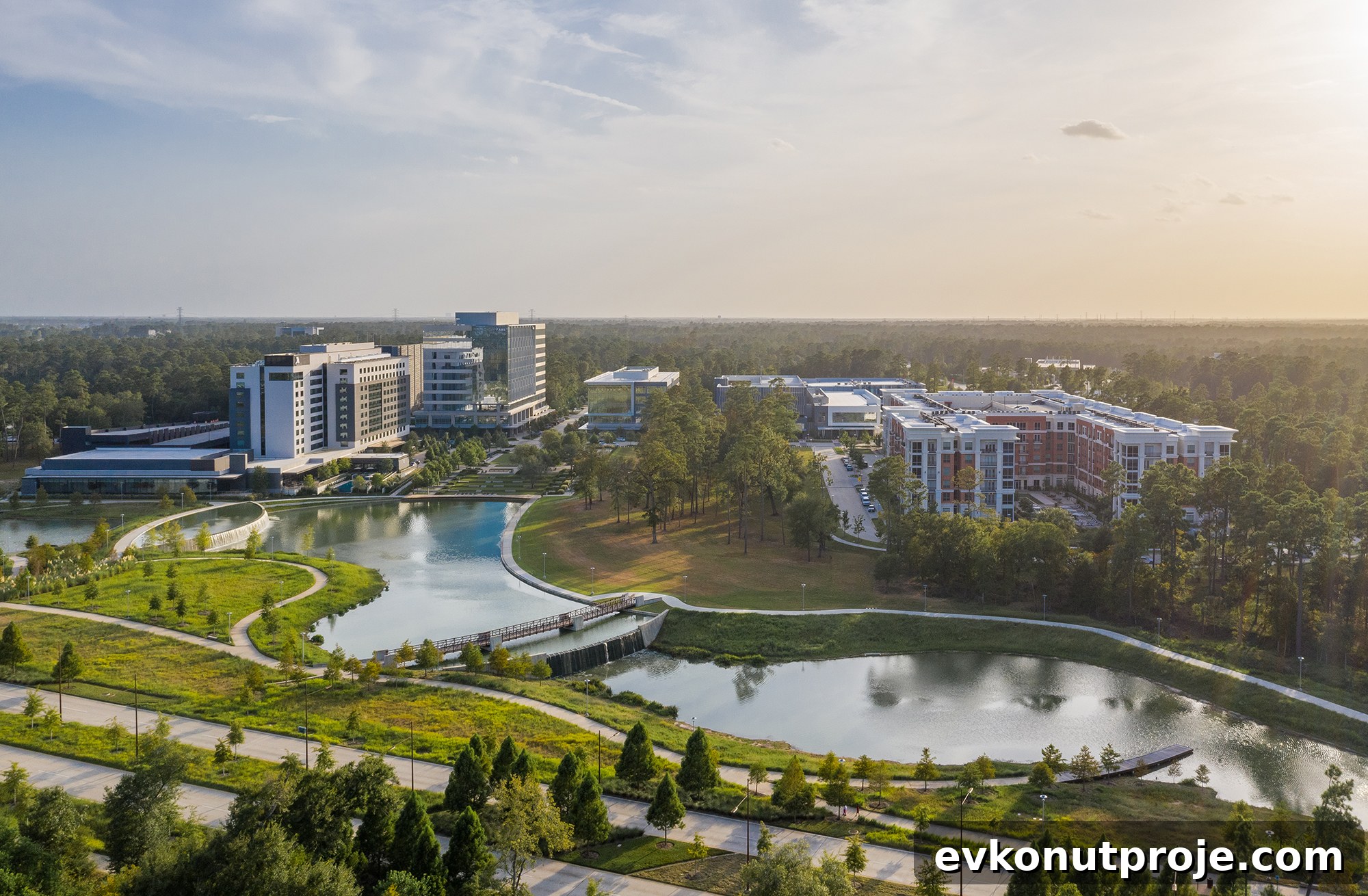
HOUSTON – (By Ralph Bivins of Realty News Report) – Designed to prioritize walkability and introduce a denser, more urban residential environment closer to the Harris County line than ever before, the planned development formerly known as Springwoods Village will depart from the typical suburban subdivision model.
A Radical Commitment to Non-Auto Transportation
The developer’s new vision: “Integrate the residential component into a sophisticated urban fabric that makes a radical commitment to non-automobile transportation.”
Springwoods Village, a 2,000-acre mixed-use area that has drawn the global headquarters of Hewlett Packard Enterprise and the 3 million-square-foot ExxonMobil corporate campus, was initially focused on commercial development.
Now CDC Houston, a subsidiary of Coventry Development Corporation of New York, is preparing to advance residential construction across 450 acres on the western side of the project. The plan calls for a distinctly urban feel, unlike many of the widely built residential communities in Texas.
The first clear sign of change was a rebranding. CDC Houston announced that “Springwoods Village” will be renamed “City Place.”
“It’s really becoming a city,” said Warren W. Wilson, Executive Vice President of CDC Houston, when explaining the name change at a recent press briefing. “As we refined the plan over the past 18 months, the Springwoods Village name felt increasingly outdated.”
Enter DMB Development
DMB Development, a community developer based in Scottsdale, Arizona, joined as a joint venture partner to lead the residential build-out of City Place.
The tract, located south of The Woodlands near the junction of Interstate 45 and the Grand Parkway, benefits from being established inside growing suburban infrastructure rather than sitting on the farthest fringe of development, said Brent Herrington, President and CEO of DMB Development.
City Place sits roughly 25 miles north of downtown Houston, while new home construction continues farther out in places like Willis, some 50 miles away. That context supports positioning City Place as an urban-infill style project appropriate to its “City” name.
The residential component will emphasize mid-density housing—an atypical mix for the Houston market. Planned products include townhomes, garden homes, patio homes, detached townhomes and several condominium styles. Some traditional single-family homes are included but will be limited, Herrington said. Phase one, with lot deliveries targeted in 2023, will deliver about 600 homes.
Turning New Urbanism Inside Out
The City Place residential neighborhoods will feature an extensive sidewalk network for pedestrians alongside separate “alternative mobility pathways” designed for bicycles and electric scooters.
“We set an audacious goal,” Herrington said. “If we get it right, you’ll be able to go anywhere without needing to cross a street busier than the one you live on.”
The development aims to make walking or electric-cycle commuting feasible. The City Place employment base already approaches 20,000 jobs, with office buildings for companies such as Southwestern Energy, St. Luke’s Health and the American Bureau of Shipping.
The green alternative mobility pathways reflect a deliberate modification of New Urbanism principles. New Urbanism, championed by planners like Andres Duany, Elizabeth Plater-Zyberk and Peter Calthorpe, promotes walkable neighborhoods with narrow, tree-lined streets, grid-like patterns and central community spaces that encourage front-porch interaction and a small-town street life.
“I love New Urbanism and have done a lot of it,” Herrington said. “The issue is that it’s very street-centric. It’s all about the street—eyes on the street.”
City Place flips that idea: many residences will front common greenbelts, pathways and open spaces while vehicular access is routed to the rear of homes.
DMB’s plan reduces the footprint of paved urban streets in favor of green corridors, functional pathways and protected bicycle lanes.
“We took the New Urbanism ideas and turned them inside out,” Herrington said. The result is an intricate framework of parks and pathways with many homes oriented toward shared green space.
Walking and cycling are priorities in the final plan. “What we want here is a radical commitment to non-automobile transportation,” Herrington emphasized.
The Team
DMB is collaborating with the Espiritu Loci planning firm from Arizona alongside local architect Jim Wendt, who brings long experience from The Woodlands.
Alex Sutton, recently retired as co-president of The Woodlands Development Company, has been appointed general manager for the CDC Houston/DMB residential joint venture.
Sutton noted Houston-area builders have shown interest in the housing types planned for City Place and in participating in a project that resembles DMB’s denser developments in the West.
Executives at the Patrinely Group, which developed several office properties and a 60-acre commercial core within the larger project, view the new residential phase as a logical complement to their work.
“City Place was conceived as a dynamic, 18-hour community,” said Robert Fields, President and CEO of Patrinely Group. “Adding residential programs enhances the character we set out to create.”
Another Phoenix Developer Comes to Space City
The last major developer from Phoenix to make a mark here was Del Webb, creator of the Sun City developments. In the early 1960s Del Webb partnered with Exxon to build the 10,000-acre Clear Lake City near NASA’s Johnson Space Center—an effort that influenced decades of large-scale master-planned development in greater Houston.
DMB’s approach to City Place, however, could reshape the region in a different way by popularizing mid-density housing—patio homes, townhomes and similar products—rather than expanding uniform, wide-lot subdivisions that favor mass production by national builders.
Herrington rejects subdividing City Place into standard 50- or 60-foot lots parceled out to large builders; he would consider that approach a missed opportunity.
“The real burden we have is to not screw this up,” he said. With tens of thousands of jobs already on site, the residential land presents a rare chance to build housing close to employment so commutes do not require car ownership.
Herrington describes ambitious goals: City Place should be socially meaningful and serve as a model for other developers. He speaks about the human cost of lengthy solo commutes and imagines developments—such as a factory campus surrounded by a walkable master-planned neighborhood—where workers could reach their jobs in minutes without driving long distances.
This “moonshot” is to push New Urbanism forward in a way that could change how master-planned communities are designed in Texas. The community’s highest aspiration is clear: to realize a development grounded in a radical commitment to non-automobile transportation.
July 17, 2021 Realty News Report. Copyright 2021.
For more about Texas real estate, see the book Houston 2020: America’s Boom Town – An Extreme Close Up by Ralph Bivins. Available in ebook and print editions.
Image: City Place’s commercial development and adjacent acreage. Courtesy: Gensler
File: DMB. How to Turn New Urbanism Inside Out: Walk, Don’t Drive, Says Developer of New Houston Project