
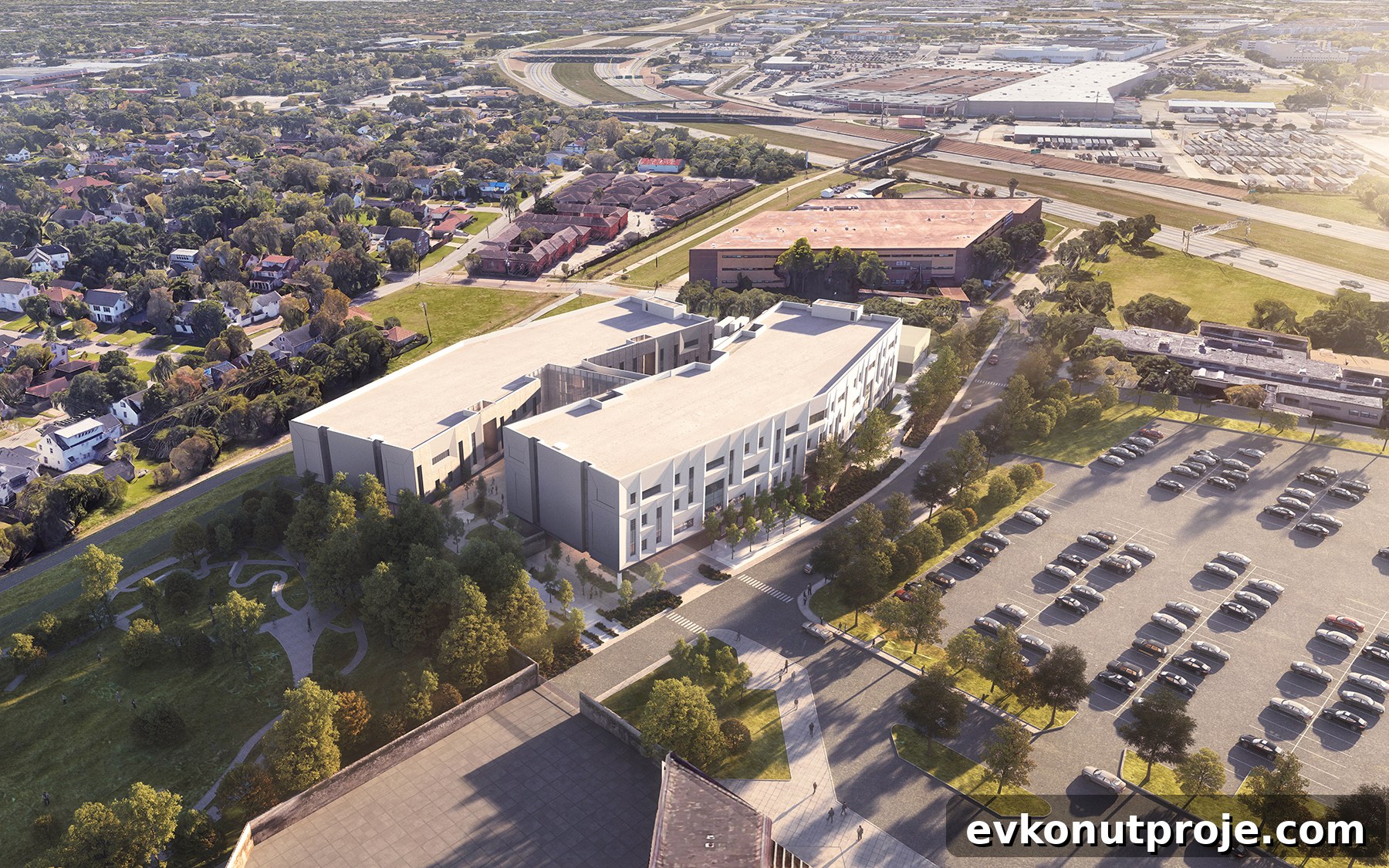
HOUSTON – (Realty News Report) – Houston’s new psychiatric hospital will be more than the largest academic psychiatric hospital in the nation; it aims to redefine expectations about what a public mental health facility can and should be.
Architect Diana Davis, principal and managing director of Perkins and Will’s Houston studio, says the design prioritizes behavioral healthcare and reduces stigma by creating a humane, healing environment. “The UTHealth Continuum of Care Campus for Behavioral Health is a transformative project that will not only provide the highest level of behavioral and mental healthcare but also work to combat stigmas on what a psychiatric hospital looks like,” Davis explains. “Knowing that behavioral and mental health is a critical aspect of one’s holistic well-being, our team was thoughtful in approaching each design decision through research and with the interest of promoting healing.”
Scheduled to open in late 2021, the 220,000-square-foot campus sits near the Texas Medical Center, just south of Brays Bayou and east of Highway 288 at 5601 W. Leland Anderson St. The project sits within a region where thousands of students and health professionals receive clinical training, enhancing opportunities for integrated academic and clinical collaboration.
The 224-bed UTHealth Continuum of Care Campus for Behavioral Health consists of two distinct buildings connected by a glazed bridge and surrounded by courtyards and landscaped outdoor spaces. The campus design emphasizes natural light, visual connections to greenery, and thoughtfully chosen materials to support patient safety, calm, and recovery.
First Major Public Mental Health Hospital in Decades
This facility represents the first major public mental health hospital built in Houston in more than thirty years. Its arrival fills a long-standing community need for accessible, comprehensive behavioral health services adjacent to Houston’s medical and academic resources.
Perkins and Will provides architecture, interior design, and landscape architecture services for the campus. The design team drew on research about the healing effects of daylight and nature, prioritizing scenic views, access to landscaped courtyards, and a warm, restorative material palette. In patient areas, daylit central living spaces are surrounded by bedrooms to encourage social interaction while maintaining safety and privacy. The team selected abuse-resistant and noise-reducing finishes and used building geometry to help mitigate sound, reducing stress for both patients and staff.
Externally, the architecture balances the integrity of a modern medical institution with the feel of a welcoming, secure, and spacious healing environment. A tree-filled exterior courtyard buffers the entrance, which sits beneath a long shaded overhang to create a clear, calming transition from the outside world into the facility.
To support recovery and reintegration, the campus includes a flexible “therapy mall” where patients can practice everyday skills in a safe, supportive setting. The therapy mall can be configured for multiple uses—salon or boutique, fitness center, movie night venue, or space for music and group therapy—allowing staff to tailor programming to patients’ therapeutic goals. Adjoining communal dining areas and the therapy mall are defined by floor-to-ceiling windows that welcome abundant daylight and offer tranquil views of courtyard greenspace. The landscaped courtyards also accommodate outdoor group therapy, passive seating, and recreational opportunities.
Designers paid special attention to staff needs as well as patient needs. The Support Pavilion, with its own separate entrance, houses an education center, break rooms, on-call sleep rooms, and a mother’s room. The pavilion was planned with flexibility in mind so spaces can adapt as program needs evolve over time.
The new inpatient beds will expand access to mental healthcare, integrated medical care, and substance use intervention and treatment. The campus supports coordinated, multidisciplinary care that guides patients toward sustained recovery and a healthy transition back into their communities.
Houston-based Vaughn Construction serves as the project contractor. Construction began in June 2019, and a recent topping-out ceremony marked a major milestone in the build. When complete, the hospital will stand as the largest academic psychiatric facility in the United States.
Perkins and Will emphasizes its longstanding commitment to design that improves lives; the firm was founded in 1935 on the belief that thoughtful design can transform communities and individual well-being.
Aug. 18, 2020 Realty News Report Copyright 2020
File: Largest Psychiatric Hospital

File: (2) Largest Psychiatric Hospital, the UTHealth Continuum of Care Campus for Behavioral Health, marks construction progress.