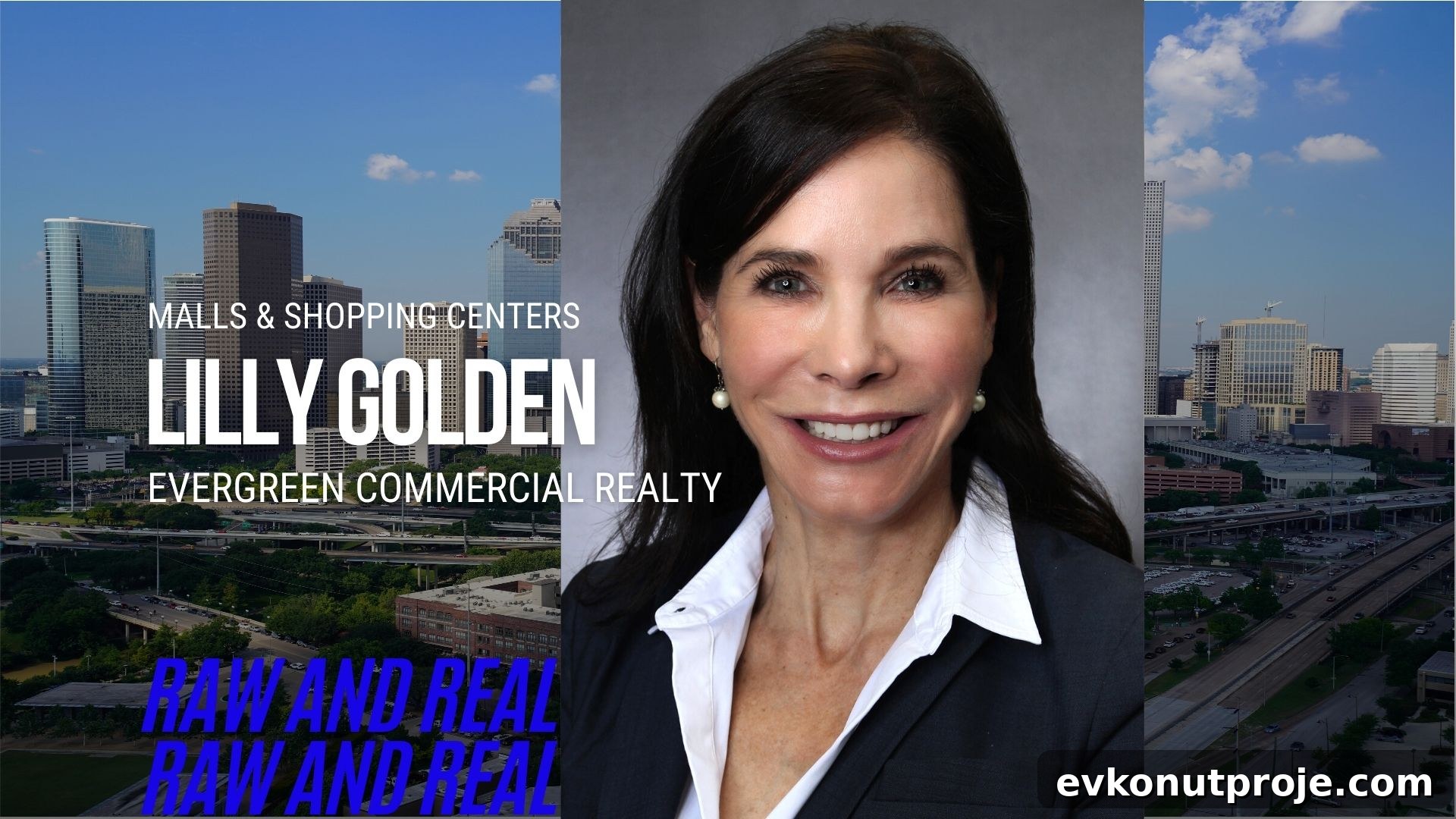
HOUSTON – (Realty News Report) – Lilly Golden is the principal and founder of Evergreen Commercial Realty, a firm that specializes in shopping centers and retail properties. She leases prominent retail and mixed-use assets in Houston’s Galleria and Katy submarkets.
Lilly Golden appeared as a guest on THE RALPH BIVINS PROJECT, a podcast produced by Realty News Report.
Ralph Bivins: Today we’ll discuss retail, malls and shopping centers. The pandemic accelerated online retail, but as we emerge from COVID, what is the current state of retail in the U.S. and here in Houston?
Lilly Golden: I’m relieved that we are largely done with drafting rent-deferral agreements tied to the pandemic. We’re moving on to new leases and transactions, which is encouraging. The economy has been supported by substantial government stimulus and by household savings accumulated while activity was restricted. That should allow many brick-and-mortar retailers to repay deferred rent and help shopping centers get back on track. I expect meaningful recovery by early 2022. In Houston we fared better than many markets because we reopened earlier. We’ve already posted two consecutive quarters of positive absorption, and vacancy declined by only about 100 basis points to roughly 6.9%. I anticipate continued positive absorption this year and a solid position by the fourth quarter.
Ralph Bivins: There’s been a major home-buying surge and widespread remote work. Given the adage “retail follows rooftops,” how do you see retail changing in the outer suburbs?
Lilly Golden: We’re already seeing development push out from Willis down to Manvel. Growth will continue along Grand Parkway and the outer loop, and in communities such as Baytown and Webster. Most new retail is grocery-anchored or clustered near supermarkets because daily needs drive traffic. Many grocery-anchored projects are already planned, though high construction costs and limited leverage have constrained new starts. As more housing is completed and new residents move in, we’ll see if construction activity follows the rooftops more broadly.
Ralph Bivins: Willis is booming. Woodland Hills, a roughly 2,000-acre development, is selling quickly, and large developers are active there.
Lilly Golden: The Kroger there has been a catalyst — its strong performance validated the area and encouraged additional development.
Ralph Bivins: What do developers and retailers look for when evaluating sites?
Lilly Golden: Retailers focus on demographics. High-end concepts require the right population density and income mix. Traffic counts matter too — retailers need sufficient customer volume and the appropriate buyer profile to achieve sales that support rent. If the customer base and traffic aren’t there, a concept won’t be viable.
Ralph Bivins: Grocery-anchored centers remain a priority. Why do they perform well?
Lilly Golden: Grocers meet daily needs and generate consistent foot traffic. People still visit grocery stores multiple times per week, even as pickup and delivery grow. That regular visitation attracts complementary retailers and provides steady activity in the shopping center. Consumers are also gravitating toward higher-quality, safer shopping environments, which benefits grocery-anchored developments.
Ralph Bivins: What about big-box stores that sell appliances, electronics and other large items?
Lilly Golden: Many big-box formats continue to perform well. Target remains very strong, and off-price retailers such as Ross, Burlington and T.J. Maxx still draw shoppers who enjoy the in-person treasure-hunt experience and can find deals that rival or beat online prices. Categories that are inherently resistant to online shopping—value-oriented discounters, experiential formats, and stores where customers want to see or test products—will continue to occupy big-box space.
Ralph Bivins: Regional malls have been under pressure; some were expected to suffer but the pandemic intensified the strain. What’s the future for regional malls?
Lilly Golden: Top-tier malls are generally stable—prime centers like the Galleria remain strong. However, many malls have lost traditional tenants to newer mixed-use and lifestyle developments. Some B- and C-quality malls will need to reinvent themselves, repurpose interior spaces, and introduce new uses. In some cases, C-quality properties will be demolished and redeveloped for different purposes. Projects should be evaluated individually, but fortunately many mall sites occupy valuable land that can support alternative uses. For example, Greenspoint in Houston is being reimagined by new investors.
Ralph Bivins: Are new retail concepts starting to emerge?
Lilly Golden: This is not an ideal moment for unproven concepts. Instead, well-known brands are rolling out updated prototypes. Examples include Starbucks expanding drive-thru formats, Walgreens testing smaller 2,500-square-foot prototypes, and Dollar General launching formats aimed at budget-conscious suburban shoppers. Restaurant Depot is shifting some locations to serve the general public in addition to businesses. Costco is testing a larger, roughly 154,000-square-foot model geared toward business customers, and many Sam’s Club locations are being repurposed as fulfillment hubs. Broadly, significant new concept growth may be limited until the pandemic recedes; I expect more announcements and prototypes to surface in 2022 as the market stabilizes.
May 11, 2021 Realty News Report Copyright 2021
For readers interested in Texas real estate, Ralph Bivins authored the book Houston 2020: America’s Boom Town – An Extreme Close Up, which examines regional development trends and includes an account of how Woody Mann of Vista developed La Centerra in Cinco Ranch.
[vc_row][vc_column][/vc_column][/vc_row]