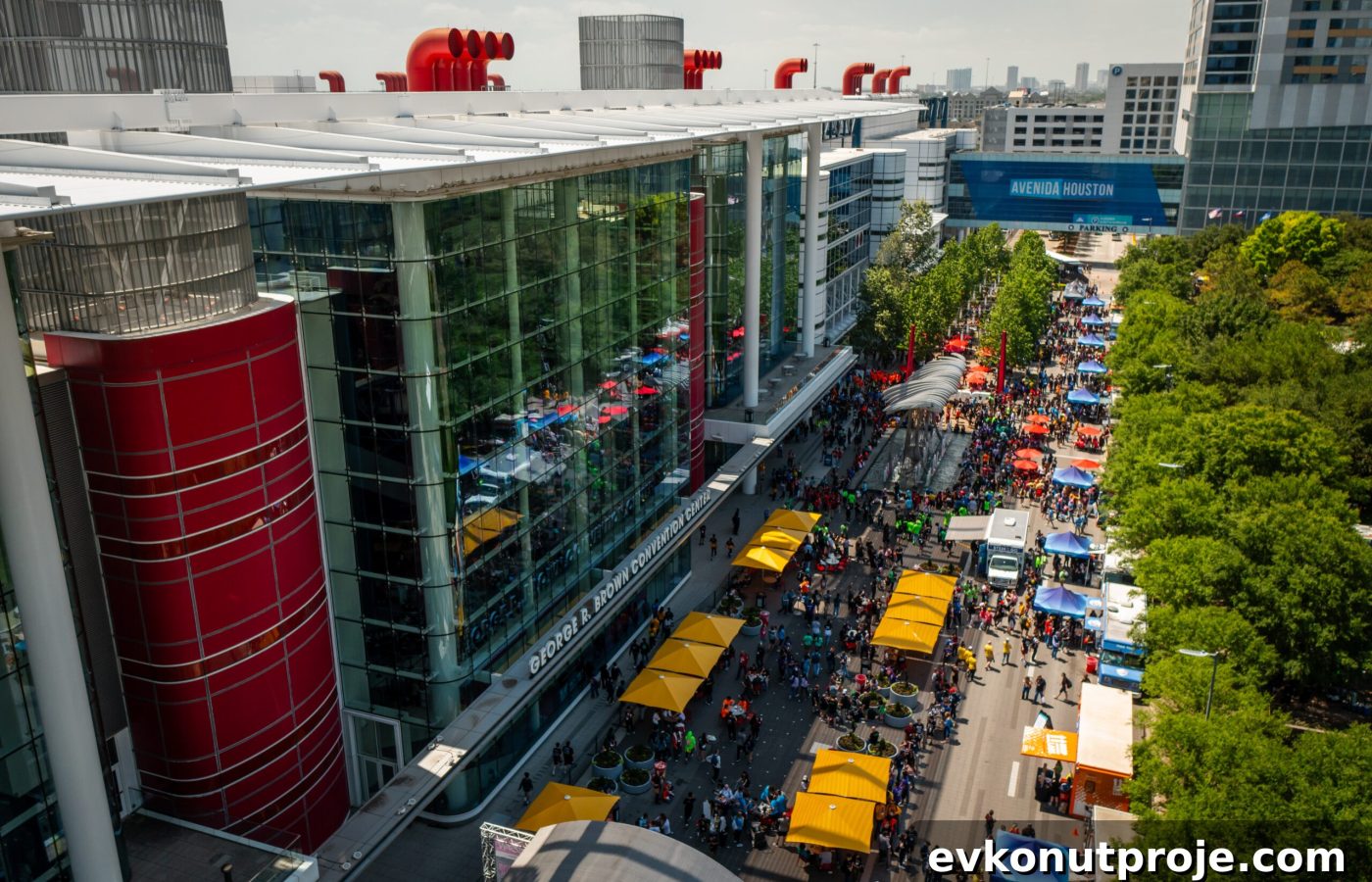
HOUSTON – (Realty News Report) – Hines, the global real estate developer headquartered in Houston, has been chosen to lead a major expansion of the George R. Brown Convention Center in Downtown Houston.
The project will add roughly 500,000 square feet on the convention center’s south side, positioning Houston to compete for larger, higher-value conventions. The city’s existing convention complex currently totals about 1.8 million square feet; when the expansion is complete, Houston First expects the convention facilities to reach approximately 2.5 million square feet.
Planners envision a new skybridge linking the expanded convention center directly to the Toyota Center arena, improving pedestrian flow and event coordination across the district.

“We are honored to partner with Houston First on the convention district transformation project,” said John Mooz, senior managing director at Hines. “As a long-standing stakeholder in Houston’s Central Business District, we recognize the importance of this ambitious effort. Our team is committed to creating a convention campus and entertainment district that showcases the best of Houston while catalyzing economic growth for the entire city.”
Hines has deep roots in downtown Houston. Founder Gerald D. Hines developed One Shell Plaza, a 50-story tower that opened in 1971 and helped define the firm’s role in shaping Houston’s skyline.
Houston First Corp., the city’s convention agency, is preparing to acquire approximately 2.7 acres of downtown land for the expansion. The parcels, known as Block 309 and Block 310, are located east of Jackson Street and north of Bell Street. Securing this land sets the stage for an eastward transformation of downtown Houston.
City planners and civic leaders are working to integrate the expansion with major transportation projects. The development is being coordinated with the Texas Department of Transportation’s I-45 re-routing and US 59/I-69 lowering projects to ensure seamless connectivity between the convention campus and surrounding neighborhoods.
A broader vision for downtown includes burying and lowering portions of the freeway network to create a deck park over the roadway, a strategy modeled in part after Dallas’s Klyde Warren Park. That project, which covers a depressed freeway, produced a new public green space that spurred nearby residential and office development. Houston’s proposed deck park—anticipated to be roughly 30 acres suspended above the lowered freeway at the rear of the convention center—could take a decade or more to complete but would be transformative for the city’s eastern edge.
Discovery Green, the successful 12-acre park that sits in front of the convention center, demonstrates how well-designed public space can energize downtown. The planned east-side green space behind the convention center aims to extend that success and stimulate investment in adjacent neighborhoods.
Houston First has emphasized that the expansion should do more than add exhibit halls. The agency hopes to create activated sidewalks, new storefronts, restaurants and entertainment options within easy walking distance of the convention campus. Those amenities are essential to making Houston an attractive destination for large conventions and increasing foot traffic that benefits local businesses.
“This is a generational opportunity for Houston to transform the eastern edge of its downtown and ensure that we remain a Tier 1 convention city for years to come,” said Michael Heckman, president and CEO of Houston First Corp.
State funding for the project will come from the state’s share of the Hotel Occupancy Tax, under legislation authored by former state senator and now Houston mayor John Whitmire. Construction on phase one of the convention center expansion is scheduled to begin in 2025.
Even at an expanded 2.5 million square feet, Houston’s convention center will remain smaller than the Las Vegas Convention Center, which totals about 4.6 million square feet. Local observers note that weather and other market factors influence convention demand; proponents argue that with improved facilities, streetscapes and public spaces, Houston can substantially increase its competitiveness.
In addition to this coverage, The Ralph Bivins Project podcast has featured numerous commercial real estate leaders and local developers discussing Houston’s growth and the convention district—including guests such as Sam Scott, John S. Moody Jr., Scott Martin, Robert Clay, Alma Zavala, Adam Lair, Jake Donaldson, Bill Baldwin, Johnny Cruz, John Breeding, Dean Strombom, Lou Cushman, Edward Griffin, Bill Odle, Rusty Tamlyn, Carlos Bujosa, Mike Spears, and Michael Scheurich.
Aug. 16, 2024 Realty News Report Copyright 2024
Image: Courtesy Houston First Corp.
File: Hines to Lead Convention Center Development