HOUSTON – (By Michelle Leigh Smith for Realty News Report) – Government-led buyouts of flood-prone properties—used widely after Hurricane Harvey, which flooded more than 100,000 homes in Houston—are gaining traction across the United States. Floodplain buyouts are increasingly recognized as an effective flood-risk reduction strategy that can also provide long-term community benefits.
Most buyouts to date have targeted single-family residences, but experts argue that commercial properties in high-risk areas should also be considered. Policymakers and community leaders are also debating how acquired land should be managed—whether preserved as open space, converted into parks, or configured to serve multiple flood-resilience and recreation functions.
ULI report: “On Safer Ground: Floodplain Buyouts and Community Resilience”
The Urban Land Institute (ULI) recently released a report titled “On Safer Ground: Floodplain Buyouts and Community Resilience,” which highlights how strategic buyouts can reduce future flood losses while delivering environmental and social benefits. The report frames buyouts as a cost-effective tool for real estate and land‑use decision-makers and as an early example of household migration away from repeatedly flooded locations—an issue likely to grow with climate change.
“Floodplain buyouts are a key tool for real estate and land use decision-makers to understand,” said Katharine Burgess, vice president of Urban Resilience at ULI and a contributing author of the report. “Buyouts show how households move away from repeatedly damaged sites and provide insight into future migration trends driven by climate impacts.”
Harris County and Inundation Pathways
Harris County, at the heart of the Houston metropolitan area, has experienced catastrophic flooding for decades. In response, the Harris County Flood Control District (HCFCD) launched a Voluntary Acquisition Program to identify parcels within likely inundation pathways and work with affected homeowners. The program has two main goals: creating public open spaces that reduce flood impacts and executing buyouts to help families relocate from unsafe areas.
The County’s Community Flood Resilience Task Force advises officials on distributing a $2.5 billion bond for flood mitigation and buyouts for households affected by Hurricane Harvey. Local community groups—such as the Westbury Civic Club—play a key role in outreach and public education about buyout options.
Craig Maske, Chief Planning Officer at HCFCD, and James Wade, manager of the Property Acquisition department, are central to the county’s buyout efforts. HCFCD manages land surrounding roughly 2,500 waterways and 1,500 bayous, and Wade oversees buyouts in dozens of severely flooded locations where rebuilding is not economically sensible. The county has secured a mix of federal, state and local funds—more than $516 million combined in FEMA, HUD and local funding—to support property acquisition and relocation assistance.
Outreach is critical to successful buyouts. Federal grants generally require that participation be voluntary, so county staff conduct door-to-door canvassing, provide fair-market offers, assist with housing searches, and offer moving and temporary storage support. That voluntary element can slow the process but helps protect homeowners’ rights and reduces the risk of displacement to predatory buyers or speculators.
After Being Flooded 12 Times, House Meets Bulldozer
Westbury Civic Club leaders cite cases where repeatedly flooded houses were demolished and the lots repurposed to improve nearby waterways. One house in Westbury flooded a dozen times before it was purchased by HCFCD in February 2021 and later razed to allow improvements along the Willow Waterhole Bayou.
In neighborhoods such as Meyerland, many homeowners have instead chosen to elevate their homes and invest in private flood mitigation rather than accept buyouts. These decisions reflect local preferences and concerns about “checkerboarding” of vacated parcels within a community.
Life, Death and the San Jacinto River
Buyouts are particularly urgent in locations along the San Jacinto River and other floodplains where flooding can be life‑threatening. In some communities, entire structures have been washed from their foundations, making buyouts a public-safety necessity. At the same time, moving from an established neighborhood can create social and psychological challenges for residents who rely on local schools, medical providers, and social networks.
“This situation is especially stressful in a post-disaster context,” Wade observes. Many homeowners waiting for buyout decisions cannot afford long delays and may sell to investors to escape uncertainty—potentially restarting the cycle of rebuilding and repeated flooding if the investor rebuilds in the same flood-prone location.
ULI Definition of Buyouts
“A floodplain buyout is a property acquisition in which a government agency purchases private property, demolishes any structures on it, and preserves the land as open space, as an area that absorbs excess water, or for both purposes. Although buyouts are currently almost entirely used for residential properties in the United States, the increased use of the approach in urban areas has important implications for all real estate types and for future land use regulation and climate resilience strategy.”
In Harris County’s Precinct 2, more than 230 buyouts have closed since Hurricane Harvey, and more than 200 additional buyouts are currently in process. County Community Development Block Grant (CDBG) funds have also supported voluntary buyouts in neighborhoods across the county. When buyouts close, covenants are recorded to ensure parcels are preserved as open space and are not redeveloped.
County officials stress protections for homeowners during the process: fair-market appraisals, time to find replacement housing, and moving assistance. These safeguards aim to prevent predatory investors from acquiring homes from vulnerable sellers and to preserve family stability during relocation.
‘The County Helped Us Find a New Home’
Homeowners who complete the buyout process often report relief and improved safety. Bedina Houston, whose house near Antoine Drive and White Oak Bayou flooded repeatedly, said the program helped her family move to a new home nearby and provided storage and moving assistance. The entire process took about 18 months and left her feeling safer and more secure outside the floodplain.
Al Spencer, another buyout participant, described similar benefits after selling his flooded home in Spring and relocating within a short drive of his former neighborhood. Even with flood insurance, the psychological burden of constant worry about flooding led him to accept the buyout and regain peace of mind.
Tools, Partnerships and Program Innovation
The ULI report outlines tools and partnership models to accelerate funding and streamline buyout implementation. Disclosure rules and coordination across funding sources can reduce property turnover before buyouts are completed. Programs such as New Jersey’s Blue Acres have used state funds to assemble contiguous parcels, creating more effective and cohesive floodplain open space.
Houston’s resilience strategy proposes pilot programs like a Community Buy-In, Buy-Out Property Swap Program to help low‑ and moderate‑income homeowners relocate within their communities, swapping higher-risk homes for safer, refurbished units nearby while converting acquired lots to flood-reduction amenities.
43,000 Buyouts Since the 1990s
Since the early 1990s, roughly 43,000 federally funded buyouts have taken place nationwide—mostly single-family homes—and activity has increased in urban counties. Some multifamily, commercial, and industrial properties have also been voluntarily sold when flood risk warranted acquisition.
Most Houston-area households who accepted buyouts relocated within Harris County, often moving to slightly higher ground nearby to stay close to jobs and community ties. Experts emphasize that water management is a critical and ongoing component of regional planning; proactive policies are needed to address known flood risks rather than rely solely on reactive responses after disasters.
Income inequality also affects buyout outcomes. Low-income households are less likely to have savings for temporary housing or rebuilding and are especially vulnerable during extended application and funding timelines. The lengthy grant-application and approval process—typically many months—remains a major barrier to faster buyouts.
HCFCD officials and local partners argue for faster, more flexible funding streams that can respond immediately after floods, rather than only funding mitigation for future events. They also note that much development in deep floodplain areas occurred before modern mapping and regulation—Harris County only began using comprehensive floodplain maps in the mid-1980s—so today’s mitigation efforts must address legacy development patterns.
Buyouts also create opportunities to expand parks and restore ecological function. Park planners and environmental managers point out that converting former residential lots into natural open space, swales, and green infrastructure can provide recreational value, strengthen flood buffers, and improve habitat connectivity in underserved neighborhoods.
Looking Ahead
As buyout programs evolve, practitioners seek to improve community engagement, integrate buyouts into broader resilience strategies, and ensure equitable outcomes for displaced residents. ULI and local partners plan to continue outreach and pilot engagements that align buyouts with climate risk management, equitable relocation options, and long-term land-use planning.
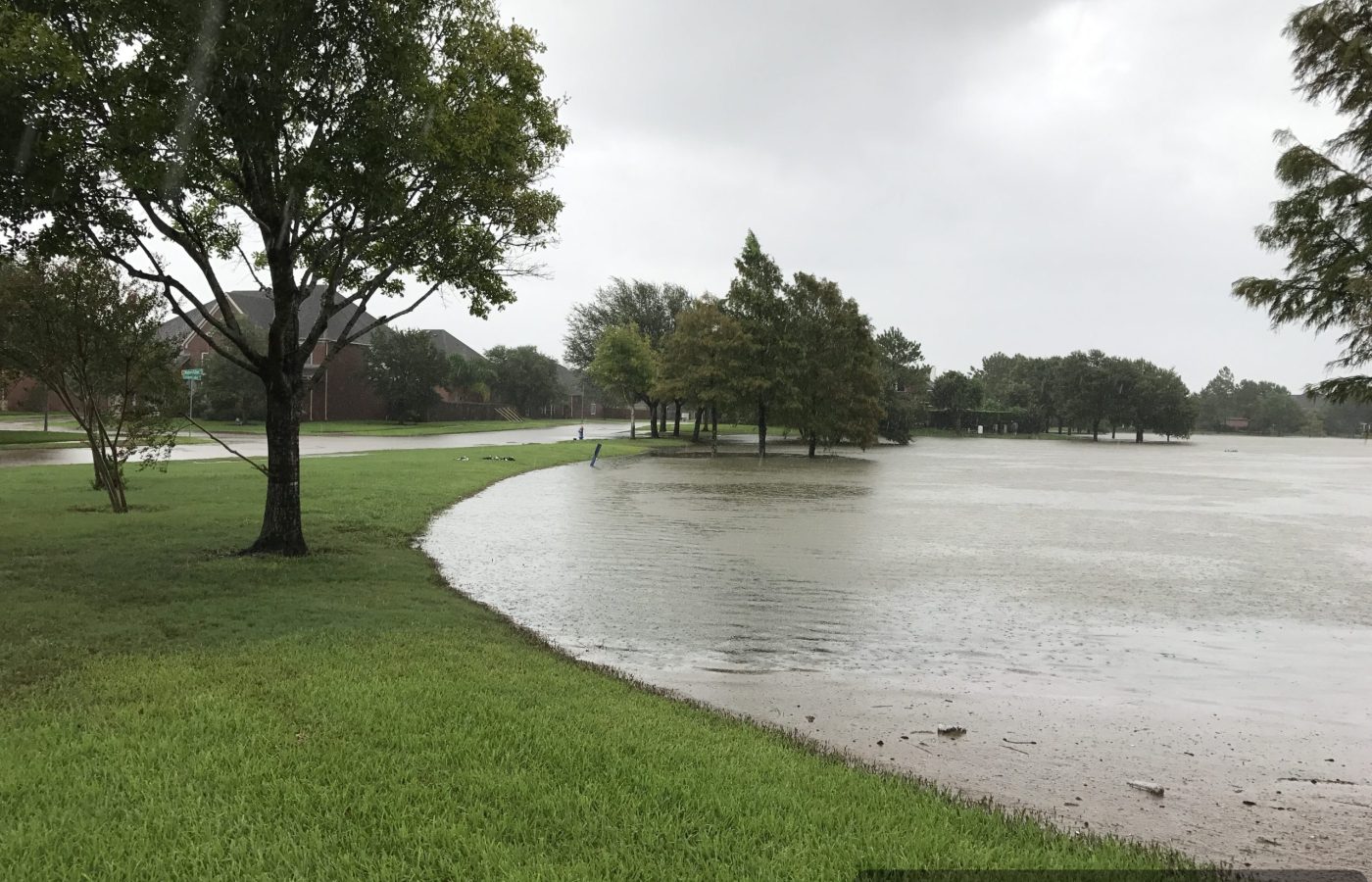
July 14, 2021 — Realty News Report. Photo: Houston during Hurricane Harvey, Aug. 2017. Photo credit: Ralph Bivins, Realty News Report.
File: Buyouts Transform Flood-Prone Neighborhoods