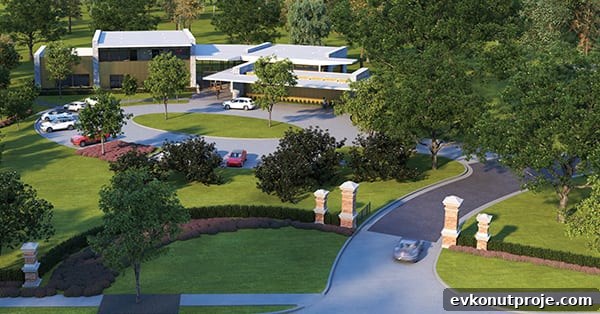
HOUSTON – The next phase of Glenwood Cemetery’s long-term revitalization will break ground in early November on a new 14,000-square-foot multi-use center. The facility will support receptions, archives and genealogy research and education, daily operations, and — finally — much-needed parking.
The Center for Glenwood Cemetery will be built on the cemetery’s northeast edge, adjacent to a 1.5-acre lake completed three years ago that serves as a water feature and irrigation source for the 88-acre property. Earlier phases of the project relocated maintenance functions to a new 13,000-square-foot building and upgraded utilities across the site.
Founded in 1871 at what was then the edge of Houston, Glenwood was designed as a garden-style cemetery that served both as a resting place and as a peaceful public recreation area in an era before formal parks. Over its 150-year history, the cemetery has preserved the original winding roads, live oaks, and wooded ravines that define its character. Headstones, statuary, and monuments reflect generations of city history alongside those whose names have faded with time.
A $15 million capital campaign launched in 2017 is funding the improvements. Executive Director Richard Arbus and project materials characterize the effort as “transformative” as Glenwood marks its 150th year of continuous operation.
Designed by Dillon Kyle Architects, the new building features a clean, minimalist aesthetic with full-height window walls framing expansive views across the cemetery. The floor plan centers on a lobby designed for gatherings and includes an outdoor terrace, office space, a kitchen, and archival facilities to support research and education programs.
The venue will also be able to accommodate weddings, a use the cemetery office frequently fields inquiries about, Arbus said. The future of the historic 1888 cottage that currently serves as the cemetery office has not yet been decided.
The project includes a new entrance off Washington Avenue. That improved access will eliminate the awkward exit into the busy Washington Corridor, Arbus wryly noted. During the center’s roughly 14-month construction period, the cemetery’s original wrought-iron entrance at 2525 Washington Avenue will be closed, with a temporary access point provided on Kane Street.
Moving buildings and adding new facilities have created roughly 2.5 acres of additional burial space, Arbus said, some plots offering striking views of Houston’s skyline.
Oct. 22, 2021 Realty News Report. Copyright 2021.
About Houston real estate: The book Houston 2020: America’s Boom Town — An Extreme Close Up by Ralph Bivins discusses recent developments in the region and related topics.
File: Historic Glenwood Cemetery Redo in 150th Year