How Buffalo Bayou Became an Award-Winning Park: Q&A with Anne Olson
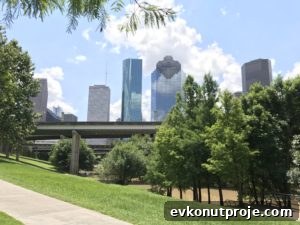
Buffalo Bayou Park offers trails leading to downtown Houston.
HOUSTON – (Realty News Report) – Flowing eastward roughly 53 miles from Katy through the Port of Houston and the Houston Ship Channel into Galveston Bay and the Gulf of Mexico, Buffalo Bayou has been central to Houston’s story since the Allen brothers founded the city nearly 200 years ago. The 160‑acre Buffalo Bayou Park is one of the nation’s standout urban green spaces and earned the Urban Land Institute Houston’s 2017 Development of Distinction Urban Open Space Award. Created through a public‑private partnership, the $58 million project included a $30 million donation from the Kinder Foundation. Hurricane Harvey, however, caused significant damage to Buffalo Bayou Park. At the Shepherd Drive Bridge, floodwaters reached 38.78 feet inside the park. Although the park was designed to tolerate flooding, no one expected three historic flood events within 18 months. To assess where Buffalo Bayou Partnership (BBP) stands a year after Harvey and to learn about upcoming plans, Realty News Report spoke with Anne Olson, President of BBP, the organization guiding revitalization along Buffalo Bayou. Over her tenure, Olson and the BBP board have helped raise approximately $200 million for the bayou’s redevelopment.
Realty News Report: Hurricane Harvey was devastating for Houston, including Buffalo Bayou Park. Can you describe the extent of the damage and how repairs have progressed?
Anne Olson: Harvey had a major impact on Buffalo Bayou Park. It was really the story of two different areas. The upper part of the park looked nearly the same a few days after Harvey, and people were still out walking and biking. The lower section suffered much more. The banks remained underwater for about six weeks as the Army Corps released water from the reservoirs, which caused significant damage. After the storm we removed over 60 million pounds of sediment, planted roughly 400 trees, repaired footpaths and renovated the popular dog park. Our recovery work continues. We are still repairing pathways and planting additional trees. The Harris County Flood Control District will address major erosion and remove remaining sediment. Under our agreement, the Flood Control District is responsible for areas of the park affected by their construction work. We also hope to secure county bond funds to begin restoring the bayou’s riparian edge.
Realty News Report: The heavy rains on July Fourth forced cancellation of the Freedom Over Texas festival for the first time in 31 years. With such extreme storms becoming more frequent, how do you respond to critics who question whether Buffalo Bayou is an appropriate location for a park?
Anne Olson
Anne Olson: Our bayous serve as natural flood detention areas when necessary. When they are not storing floodwater, they provide substantial recreational and environmental benefits for the community. During the park’s design and when planning maintenance, we took major storm events into account. Still, no one anticipated rainfall on the scale of Hurricane Harvey. Beyond planning, we invested in staffing and systems: we have a skilled park crew with established procedures for responding to flooding events, which helps us recover more quickly.
Realty News Report: Flooding remains a critical challenge for our city. Having worked on bayou restoration for years, what observations or recommendations would you share?
Anne Olson: I expect significant rain events to continue. While we hope not to see another Hurricane Harvey, major storms are likely. We’ve partnered with several environmental organizations on a Headwaters to Baywaters initiative. With recent private funding, we are researching the benefits of acquiring and restoring land along bayous. Restored green spaces can absorb and retain stormwater, so it’s vital to pursue green infrastructure alongside traditional gray infrastructure like channels and reservoirs.
Realty News Report: Buffalo Bayou Park on downtown’s west side has transformed over the past five to ten years. What’s next for the park?
Anne Olson: Buffalo Bayou Partnership is pursuing several projects to continue revitalization. In downtown, we plan to extend the bayou trail from Allen’s Landing to US 59, where it will connect with a trail currently being built by TxDOT near the Houston Housing Authority’s Clayton Homes site. We are also completing a major planning effort for the bayou’s East Sector. Over the past year we’ve gathered input from neighborhood residents and stakeholders about their priorities for this stretch. We expect the final plan to be completed by year’s end.
Realty News Report: Midway’s proposed 147‑acre East River development on the former KBR site east of downtown includes more than a mile of bayou frontage. How might that project affect bayou improvements?
Anne Olson: BBP holds a trail easement along the East River property. We hope to coordinate with Midway to develop that trail soon. Completing this segment would close a crucial gap in the bayou’s continuous trail network.
Realty News Report: For readers new to Houston, can you summarize what was accomplished in the $58 million Buffalo Bayou Park project, including trails and pedestrian bridges?
Thousands of Houstonians attend festivals at Buffalo Bayou Park.
Anne Olson: Buffalo Bayou Park offers a wide range of amenities. Beyond the extensive trails and footpaths, visitors enjoy a children’s play area, a large dog park, and two visitor centers that provide canoe, kayak and bike rentals. The Lost Lake Visitor Center houses a café and The Dunlavy restaurant, while the Wortham Insurance Visitor Center contains the Cistern, a distinctive underground reservoir repurposed for art installations and public tours. Thousands of visitors from around the world have toured the Cistern. The park balances active recreation with quiet natural areas for picnics and wildlife viewing and provides striking views of Houston’s downtown skyline. It’s a multifaceted urban park that serves many needs.
Realty News Report: Has anything in the park been more popular than you expected?
Anne Olson: We anticipated the dog park would remain popular—Houstonians have long brought their dogs to this area. What has pleasantly surprised me is how broadly the park appeals across Houston’s diverse population. People of all ages and backgrounds use the park, and it’s common to hear many languages during a single visit. That wide embrace reflects the park’s success as a public space.
Realty News Report: The bayou also runs through Memorial Park, where a major redevelopment is planned. How is the bayou being considered in those plans?
Anne Olson: Memorial Park’s master plan emphasizes conservation, and as a result it does not propose a trail along the bayou’s edge. The Memorial Park Conservancy intends to pursue riparian restoration, keeping the bayou in a more natural state and focusing on ecological enhancement and habitat protection rather than additional recreational infrastructure.