Bank of America Tower Opens: Houston’s New Skyscraper Complete
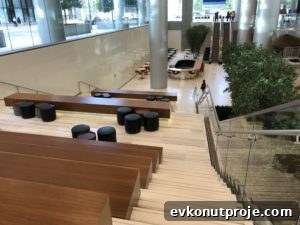
The “Great Steps” lead to the food hall at the new Bank of America Tower lead to a food hall. Photo by Ralph Bivins, Realty News Report
HOUSTON – (By Ralph Bivins, Realty News Report) – Houston’s newest downtown skyscraper, a sleek 35-story tower with an innovative approach to its below-grade level, has been officially named Bank of America Tower.
The announcement was made Wednesday by developer Skanska and anchor tenant Bank of America, which has leased approximately 205,000 square feet of office space and an additional 5,000 square feet for a street-level banking lobby.
During construction the building was commonly known as Capitol Tower. With completion, Skanska and Bank of America have confirmed its permanent name: Bank of America Tower.
Sited at 800 Capitol Street, the 754,000-square-foot tower occupies a full block bounded by Travis, Milam and Rusk streets in the heart of downtown Houston.
The tower opens with nearly 90 percent of its rentable area leased. Tenants were attracted by high-quality, next-generation office amenities — including a large open-air garden park on the 12th floor, a modern fitness center, and a curated food hall — as well as the building’s strong sustainability credentials.
Designed by Gensler, the Skanska building invites the public into a dramatic open atrium that connects the street level with the below-grade area via a 30-foot-wide staircase and a terrace outfitted with substantial wooden benches and furniture-quality seating.
Presiding at the tower’s event Wedneday were Bob Eury, president of Central Houston; Matt Damborsky of Skanska, Hong Ogle of Bank of America and Robert Ward. president and CEO of Skanska USA Commercial Development. Photo: Ralph Bivins, Realty News Report.
The design features glass frontages along Milam, Capitol and Rusk streets and an open atrium above the basement, welcoming pedestrians from the sidewalk rather than isolating them, as many downtown towers do when they push circulation into underground tunnels.
The tunnel-level food hall is part of a national food hall trend focused on chef-driven concepts and social dining, appealing particularly to millennials and other urban workers and residents.
Unlike traditional downtown food outlets with weekday hours only, this food hall operates seven days a week to serve a broader audience.
Skanska has branded the 35,000-square-foot food hall “Understory.”
Understory houses seven distinct chef-driven outlets and a cocktail bar, offering a range of culinary options under one roof.
Michael Hsu Office of Architecture designed Understory’s central feature: the open-air connection between the street and tunnel levels anchored by the “Great Steps,” a monumental staircase that creates what Skanska calls the first true street-level gateway to the downtown tunnel network.
Austin-based Michael Hsu has gained recognition for his restaurant and food hall designs and was chosen to shape Understory’s dining environment.
The Bank of America Tower project traces back to 2011, when Skanska purchased the former 18-story Houston Club building at 811 Rusk and demolished it to create a full-block site for the new tower.
Construction milestones included a major foundation pour on August 22–23, 2015. That work coincided with a sharp decline in oil prices that led Houston energy firms to downsize and leave large blocks of office space vacant, creating uncertainty across the local market.
Skanska’s new downtown building has a 12th-floor garden called SkyPark. Photo: Ralph Bivins, Realty News Report.
Observers questioned the timing of a major new office project amid rising vacancy, but Skanska approached the development differently. Skanska USA Commercial Development, a division of Stockholm-based Skanska AB, internally financed the project without a traditional bank loan. Skanska AB is a global construction and development company with substantial resources.
After completing the foundation, Skanska slowed visible construction while leasing efforts continued. The project’s momentum shifted when Bank of America signed on as the anchor tenant, and vertical construction resumed in 2017.
The building’s leasing success exemplifies a common industry pattern known as the “flight to quality”: while overall office vacancy in Houston has been high, new, well-designed buildings with modern amenities have attracted tenants seeking higher-quality space. According to NAI Partners, citywide office vacancy is 20.9 percent, yet new downtown towers, including this one and recent Hines projects, have leased quickly.
Bank of America Tower is opening at roughly 88 percent occupancy.
Current tenants include:
Skanska (12,481 SF, floor 12)
Bank of America (210,000 SF, floors 14–20)
Winston & Strawn (62,515 SF, floors 23–24)
Waste Management (284,000 SF, floors 25–33)
Quantum Energy Partners (32,000 SF, floors 35–36)
The building also prioritizes sustainability. It is among a limited number of U.S. projects to achieve LEED Platinum v4 certification and features systems such as rainwater recycling to reduce environmental impact.
With this completion, Skanska plans to continue development activity in Houston, according to Robert Ward, president and CEO of Skanska USA Commercial Development.
Matt Damborsky, executive vice president for Skanska USA Commercial Development in Houston, remarked, “For the last two years, Capitol Tower has been an icon rising in Houston’s skyline.”
The Bank of America Tower is the first new downtown office tower since Hines completed 609 Main at Texas in 2017, and it now joins Houston’s skyline as a modern, amenity-rich addition.
Skyline watchers will next turn their attention to Hines’ Texas Tower, a planned 1 million-square-foot office development on the former Houston Chronicle block on Texas Avenue, expected to rise in the coming years.