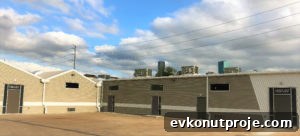
Creative Hub Expands: More Artist Studios Join 55-Acre Arts District
Sabine Street Studios in Houston
HOUSTON – (By Cynthia Lescalleet for Realty News Report) – The opening this weekend of Sabine Street Studios on the 55-acre Sawyer Yards campus brings another cluster of workspaces for artists and creative entrepreneurs. The new building reinforces the campus’ mission of transforming former industrial properties into a hub for arts, culture and compatible businesses.
Developer Jon Deal of The Deal Co. says Sabine Street Studios shares the personality of the other converted properties on the campus but also introduces several notable differences.
For starters, the building’s scale distinguishes it. At 48,000 square feet and a single-story layout, Sabine Street is smaller than some of the larger converted structures on the Sawyer Yards campus. Yet it still accommodates 67 workspaces, two gallery areas and broad corridors designed for events and public circulation.
The studio’s ownership structure is another point of difference. Deal partnered with Steve Gibson and Frank Liu, founder of Lovett Homes, to acquire and redevelop the former Halliburton plant. All three are established contributors to Sawyer Yards projects, and on this property they share ownership and management responsibilities.
Sabine Street also offers larger studio spaces—some up to 2,500 square feet—that might attract small creative enterprises and startups. Deal is clear, however, that tenants must contribute to the campus’ creative culture: “Arts-oriented endeavors, yes. Traditional accountants, not so much,” he says. In short, businesses without an artistic or creative focus are unlikely to be approved.
The renovation of the former industrial building took about 18 months, including an arduous nine months just to secure permits. Prior to the public opening, roughly 60 percent of the studios were leased.
Situated across from Spring Street Studios, Sabine Street sits slightly north of the other converted buildings in Sawyer Yards, located near downtown in Houston’s historic First Ward and the Washington Avenue Arts District—a designation recognized by the Texas Commission on the Arts in 2014.
Over the past 14 years, Deal and his partners have renovated a series of former industrial properties into artist-focused spaces: Winter Street Studios, Silver Street Studios, The Silos at Sawyer Yards, Summer Street Studios, the Tech Center, 2500 Summer St., The Shops at Sawyer Yards, and now Sabine Street Studios. Together these spaces support more than 400 working artists and creative businesses.
As the campus has matured, it has also drawn dining, entertainment and retail uses, creating a mixed-use destination. “We envision the campus as a destination of complementary uses,” Deal explains. Earlier plans to introduce live-work-play residential units were explored but ultimately set aside. Deal adds that a shared co-working operator could be a welcome addition if the right partner emerges.
No Exit Strategy
Deal says he intends to remain engaged for the long term. “There’s no exit strategy,” he says. He has been involved from the beginning, dating back to his redevelopment of Winter Street Studios in 2005, where he formalized a nascent artist community that had already begun occupying the building informally.
To recruit the initial group of about 30 artists for Winter Street, Deal consulted with abstract artist Sandi Seltzer Bryant for roughly a year and a half. Bryant remains one of the original tenants and describes herself as a “purist” when it comes to studio spaces dedicated to working artists. She says the development has exceeded her expectations.
Bryant emphasizes that from the outset she insisted on practical improvements that artists need: clean, secure spaces, functioning restrooms, climate control and reasonable rents. Achieving affordable rents has grown more difficult as land and construction costs have climbed. Deal notes that early projects operated on costs near $10 per square foot; today comparable projects can reach $75 per square foot or higher, driven in part by intensified residential development around the First Ward.
The changing neighborhood has made it tougher to finance and justify additional conversions of existing industrial buildings. Each building on the campus has carried different renovation costs, which produces variation in rental rates and tenant mixes. While not every tenant is a practicing artist, Deal stresses that the campus prioritizes creative uses.
Deal prefers adaptive reuse over new construction. Though renovating older buildings brings unique challenges—structural, regulatory and financial—he says those difficulties are offset by the cultural and civic rewards. “There’s some sacrifice on ROI, but it has been great to add a cultural gem to the city,” he says, noting that converting industrial property into creative space helps validate the arts as an economic and cultural asset for Houston.
With more than 400 creative professionals working on site, Sawyer Yards ranks among the largest artist communities in the United States. Bryant notes that each newly renovated building sparks interest among current tenants; artists often relocate within the campus when new studios come online, sometimes sharing space to absorb higher rents.
Organized and Ad Hoc Public Programming
Sabine Street Studios opens officially during Sawyer Yards’ Spring Biannual Art Stroll, when hundreds of artists open their studios to the public. In addition to the semiannual Art Stroll, Sawyer Yards presents a monthly, free public event called Second Saturday, when artists may choose to welcome visitors. Participation varies—some artists open their studios regularly, others infrequently.
With so many buildings, studios, galleries and dining options across the 55-acre campus, Deal acknowledges that exploring everything in a single day can be challenging. Individual buildings and artist groups now host their own exhibitions and events; Sabine Street Studios is planning its first solo exhibition for the summer, “TPS 27: The International Competition.”
“We’re excited about the way Sawyer Yards continues to evolve as an arts and entertainment destination in Houston’s urban center,” Deal said in the Sabine Street Studios announcement. Artist-tenant Sandi Seltzer Bryant, who watches the campus’ evolution closely, remains cautiously observant: “We’ll see,” she says.