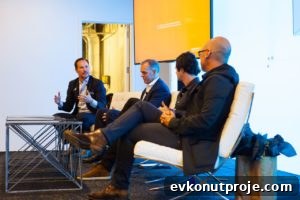
HOUSTON – Alchemy and amenity-rich design were the focus of a recent panel held at GreenStreet, the mixed-use project developed by Midway Companies in downtown Houston. Four leaders in architecture, office design and real estate development discussed national trends and the creative thinking reshaping modern work and urban environments.
Midway CEO Jonathan Brinsden introduced the panelists: John Lewis of WeWork, Dean Strombom, a principal with Gensler, and Mark Motonaga, a principal at Rios Clementi Hale Studios. Motonaga, who is based in Los Angeles, led much of the reimagining of GreenStreet as a downtown corporate campus, positioned at the intersection of a heavily used METRO rail line and a redesigned retail corridor.
Brinsden framed the conversation around user-focused design, emphasizing models that “serve users, not just house them.” The message set the tone for examples and strategies each panelist shared for activating space, supporting collaboration and improving workplace performance.
John Lewis, visiting from New York, described how WeWork activates environments to better engage employees and teams. He explained that WeWork’s model “de-couples the need for large capital outlays and long-term leases,” allowing organizations to access flexible, amenity-rich space. Lewis cited the Ace Hotel in Manhattan as an example of “space as service”: a lively, idea-driven environment where social and work areas blend. He shared a layout example where only half the square footage is dedicated to assigned workstations while the remainder supports soft seating, storage and circulation—spaces intended to be used by many people. “By opening it up to be used by many, there’s an alchemy: people get more amenities and pay less. That’s magic for a CFO,” he said, noting WeWork’s growing engagement with major corporations.
“We are setting the tone for how people work,” Lewis added. “This is about placing the human back into the workplace.” His remarks emphasized human-centered design and the importance of environments that inspire interaction and productivity.
Dean Strombom, who leads Energy Practice initiatives at Gensler and focuses on workplace performance, explained how conventional office layouts can limit employee effectiveness. He highlighted signature projects—Airbnb and Facebook offices in San Francisco, The Garage at Northwestern University in Evanston, and Etsy’s Brooklyn-rooted headquarters—as examples of workplace design that enables collaboration and creativity. Strombom pointed to recent Gensler work in Houston, including the Houston Chronicle’s new offices at 4747 Southwest Freeway, where shared amenities such as print centers, a well-equipped kitchen and communal coffee areas support both the editorial mission and team interaction.
Strombom described Gensler’s C3 Culver City spec office building as a forward-looking example. “Every other floor has 20-foot ceilings, allowing tenants on those floors to add mezzanines to accommodate growth,” he said. The project also leverages interior and exterior stair configurations to create dynamic connections between floors and encourage movement and interaction.
Brinsden also highlighted Midway’s other projects, including Century Square in College Station near Texas A&M University. He described Century Square as a 60-acre, walkable environment that will combine retail, restaurants, entertainment, roughly 60,000 square feet of office space and two hotels adjacent to the campus. Brinsden’s background includes an M.S. in Land and Real Estate Development, a B.S. in Construction Science and a B.S. in Environmental Design, all from Texas A&M.
All four panelists agreed that mixed-use, walkable environments are increasingly favored by younger workers and by organizations seeking to attract and retain talent. GreenStreet—a four-level, 570,000-square-foot development designed to foster connectivity—served as an apt backdrop for the discussion.
GreenStreet occupies three downtown Houston blocks bounded by Dallas, Polk, Caroline and Main streets, near the new Marlowe condominium tower. Midway developed GreenStreet in partnership with Lionstone Investments, and Colvill Office Properties manages leasing. The development features a central open green called The Lawn, approximately 90,000 square feet of office space, and multiple dining and retail options including House of Blues, McCormick & Schmick’s and III Forks. A 223-room Hotel Alessandra is scheduled to open later this year, adding a hospitality component to the project.
The panel made clear that successful modern developments blend human-centered workplace design, flexible “space as service” models and vibrant public spaces to create environments where people want to work, meet and live.
Jan. 16, 2017 Realty News Report Copyright 2017