(RNR) – By Ralph Bivins —
THE FABLE: Once there was a Texas boy who grew into a young man and admired a young woman.
The high point of his day — the single word that made his heart race — was hearing her say “here” during homeroom roll call.
At school, a small army of girls clustered around her like little offensive linemen, blocking anyone who tried to get close. He thought about her all summer and wondered how he could ever talk to her.
The following year, a rare chance arrived. She was sitting alone in the cafeteria at lunch. He joined her, and she immediately stood up. Without making eye contact, she spoke his name for the first time.
“Sam, would you take care of my tray?”
He watched her walk away, his heart pounding as he carried her dirty dishes to the dishwasher.
The next week he called her. She chatted about plans to buy new clothes and then turned down his invitation to the movies. Over the next six months he asked six times; she said no each time and dated other men instead.
Both ended up at the University of Texas in Austin, where he spotted her in freshman English. Over the following year she declined several invitations. He shaved off his mustache, bought new clothes, and tried to change — all to no avail.
Finally, while they crossed a large campus plaza, he spoke to her honestly and without anger.
“Why do you go out with other guys but never with me? What’s wrong with me? Just be honest and tell me,” he pleaded. “What’s wrong with me?”
“We’re just not a good match, Sam,” she replied.
THE FACTS: In January, President Trump told CNBC that Elon Musk was planning to build a large Tesla auto factory in the United States.
By March 10, details began to trickle out via Musk’s Twitter account. Musk said scouts were searching for a factory site for a plant that would produce the Cybertruck pickup and a compact SUV called the Model Y — electric vehicles that run on battery power rather than gasoline.
Musk tweeted that a factory site in the middle of the United States — pickup truck country — was preferred because it would make shipping to the East Coast easier.
In economic development circles, a Tesla plant is a major prize; everyone knows Tesla will seek substantial tax incentives.
The Wall Street Journal quoted Musk directly: “Incentives play a role, but so do logistics costs, access to a large workforce with a wide range of talents, and quality of life.”
During the spring of the COVID-19 crisis, Houston largely sat on the sidelines while other cities actively courted the Tesla plant. Rumors suggested Tesla might hire 10,000 workers and build a factory of more than 4 million square feet.
Houston officials did not expect an RFP (Request for Proposal) from Tesla. The city failed to meet federal Clean Air Act ozone standards, which officials believed would complicate approval for a car plant. That perceived barrier left many local leaders resigned to pursuing chemical plant expansions instead of chasing auto manufacturing.
It’s unclear whether any Houston official asked for an exception to the Clean Air Act rules; Tesla’s Reno Gigafactory is powered by solar energy and operates close to net-zero emissions, which could have been an argument in Houston’s favor.
As national lockdowns continued and Tesla’s plant near Oakland remained closed due to local mandates, production backlog mounted. On May 9, Musk tweeted that he was suing California officials over the shutdown and later announced that “Tesla will now move its HQ and future programs to Texas/Nevada immediately.”
Even the possibility of Tesla relocating its headquarters sparked a rush of interest. On May 15, Houston Mayor Sylvester Turner sent Musk a letter inviting Tesla to Houston. Also that day, Associated Press auto writer Tom Krisher reported that Austin and Tulsa were finalists for the new plant.
No public RFP has ever been produced. It appears the selection leaned heavily on Musk’s own discretion, as he juggled Tesla plans alongside SpaceX rocket missions.
The competition became a very public Austin vs. Tulsa battle. On May 17, Tulsa’s mayor pledged the city police force would drive Cybertrucks if Tesla moved there. Tulsa even repainted its 75-foot Golden Driller statue with the Tesla logo, signaling a symbolic shift from oil to electric vehicles.
Tulsa’s efforts failed to sway Musk. On July 22, he announced that Austin had won the factory site. The $1.1 billion plant would be located east of Austin, employ about 5,000 workers with an average pay of $47,147, and have roughly 65 percent of positions filled by workers without college degrees.
The facility was planned as a 4.5 million-square-foot plant near the Colorado River in southeastern Travis County. Tesla’s incentive package included roughly $61 million in tax breaks from the Del Valle school district and Travis County. Tesla paid $97 million for 2,100 acres from Martin Marietta, a company that had mined gravel on the site for years.
Musk described the factory as a park-like “ecological paradise” with streams and hiking paths, though the site had largely been gravel pits nearing depletion.
THE FLAW
Tesla’s Austin Gigafactory will be enormous and busy. With about 5,000 employees commuting to and from the site, significant traffic will be generated around the intersection of Texas 130 and Harold Green Road, where construction has already begun.
Texas 130, a four-lane highway, is being widened to six lanes, but concerns remain about whether local infrastructure can handle the traffic of employees, suppliers and finished vehicles.
Notably, the Tesla property lacks a railroad spur. Connecting to the nearest rail line would require an eight-mile haul up Highway 130. That absence raises questions about how vehicles and parts will be transported efficiently.
Perhaps Tesla plans to rely on its own semi-trucks for overland transport, but Austin’s long-haul options are limited compared with other Texas locations. Interstate 35, heavily congested and linking Austin to Dallas, is not ideal for large-scale shipping.
While Elon Musk is widely admired for his vision and innovation, the Austin site presents logistical drawbacks in terms of shipping and access. Some observers call it a potential future failure for freight and commuter flow.
By contrast, a Houston location would have offered advantages: deep-water access via the Port of Houston, on-site rail spurs, multiple interstate highways (I-10, I-45, and I-69), and multiple airports — all stronger logistics assets than Austin’s site.
In short, from a transportation and distribution perspective, Houston would likely have been superior.
THE FICTION: The common explanation from unnamed sources is that Tesla chose Austin over Houston because Austin has a strong tech workforce.
While Austin does host major tech companies like Google, Apple and Facebook, the Tesla plant is primarily an auto assembly facility. The average pay at the Austin Gigafactory is projected to be under $50,000 a year, and about two-thirds of employees will not hold college degrees.
Tech talent is valuable, but an auto plant requires large numbers of production workers, line technicians, and logistics personnel — roles that do not necessarily depend on the presence of Silicon Valley–style technology firms.
Houston has its own supply of tech-savvy workers and a sizable industrial workforce capable of filling many of Tesla’s needs. Not long ago, Amazon also bypassed Houston during its HQ2 search. Now, some argue Houston lacks the “tech firepower” needed to land a Tesla factory — a conclusion that many find hard to accept.
Perhaps a direct conversation between Houston leaders and Elon Musk could have clarified the decision. Houston still asks bluntly: “Just be honest and tell me — what’s wrong with me?”
Commentary by Ralph Bivins, editor, Realty News Report
Sept. 14, 2020 Realty News Report Copyright 2020
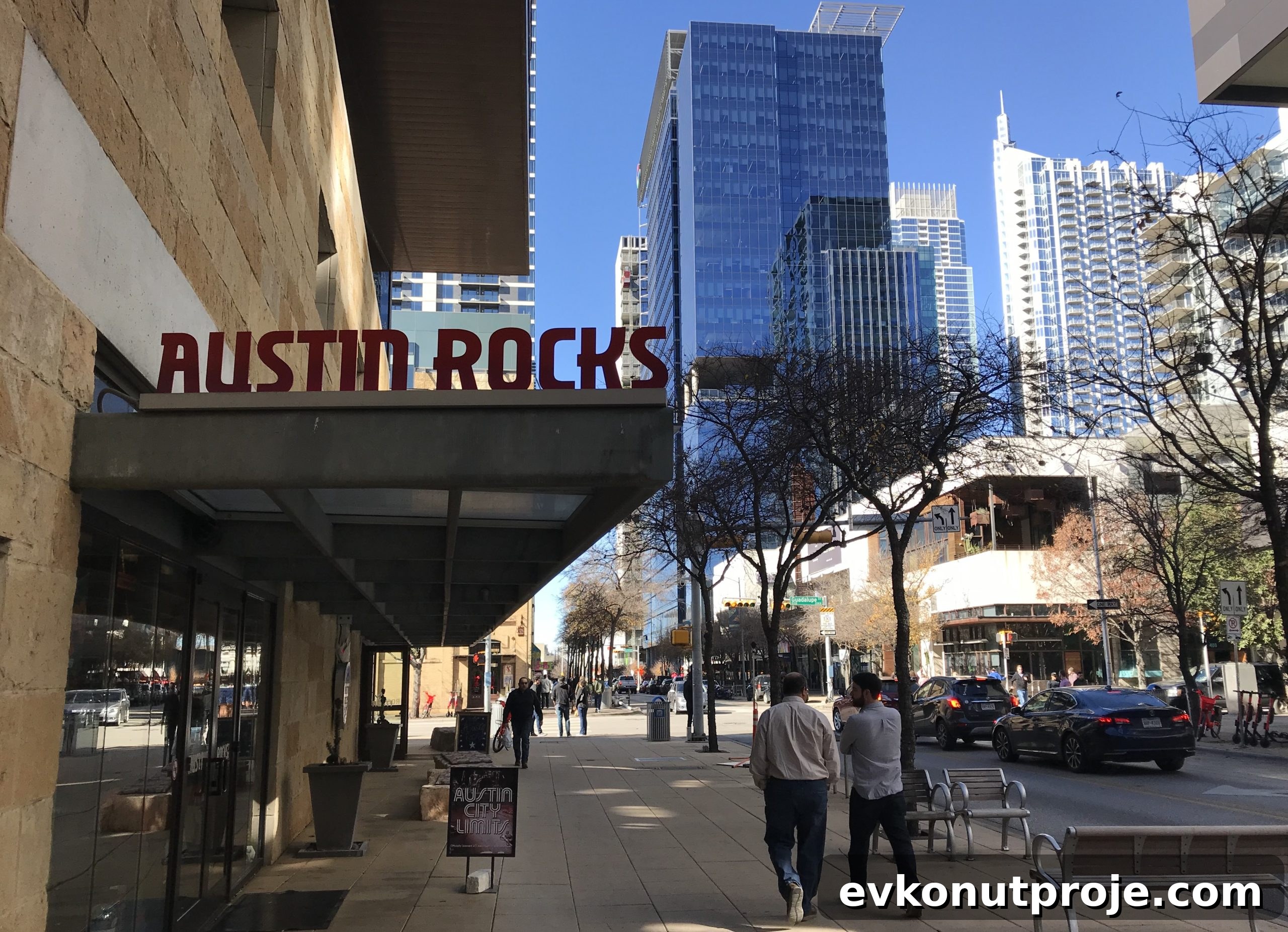
Photo: Downtown Austin. Photo credit: Ralph Bivins. Copyright 2020
File: Tesla in Texas