Realty News Q&A: Scott Ziegler, AIA of Ziegler Cooper Architects — Part 2
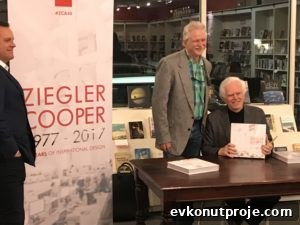
Scott Ziegler at book signing. Photo: R. Bivins
HOUSTON – (Realty News Report) – Scott Ziegler, AIA, Senior Principal at the Urban Residential Studio of Houston-based Ziegler Cooper Architects (ZCA), is an urbanist whose work has shaped Houston and affected the lives of many Houstonians. Realty News Report sat down with Ziegler for an in-depth interview about Houston’s changing density and his new book, “Ziegler Cooper: 40 Years of Inspirational Design.”
This is Part Two of the Ziegler interview. To see Part One CLICK HERE.
Realty News Report: We’ve discussed urban densification and are curious about what lies ahead. From your research, how do you see Houston growing in the years ahead? The central business district? The suburbs? New towns like The Woodlands?
Scott Ziegler: I see a convergence of lifestyle changes that are driving demand for urban living across the city — in the Texas Medical Center, Midtown, the Galleria, River Oaks and CityCentre. People want shorter commutes and more time to enjoy their neighborhoods. They want to walk to work and to everyday amenities like supermarkets, coffee shops and restaurants. Remote work and shared workspaces are also reshaping where people choose to live. We’re seeing residents locate closer to employment centers; Upper Kirby now features residential towers alongside office buildings, and River Oaks is seeing similar patterns. Overall, I’m very confident about Houston’s future growth.
Realty News Report: What about the new 3 million-square-foot ExxonMobil campus on 385 acres, roughly 25 miles north of downtown? Why is that development significant?
Scott Ziegler: Large corporate campuses serve a real business need: consolidating thousands of employees in one place. The Exxon campus was designed to house about 10,000 employees. But from an urban-planning standpoint it’s isolated — an island set apart from surrounding neighborhoods. Security concerns drive such designs, and while they work for corporate operations, they run counter to planning principles that promote high-density, mixed-use, walkable communities with less dependence on cars.
Realty News Report: Speaking of ExxonMobil, what is the status of the vacant Exxon high-rise at 800 Bell downtown?
Scott Ziegler: The owners intended to redevelop the building into a modern workplace to remain competitive. Our proposal was to gut the structure back to the concrete slabs, increase net rentable area by deepening bay depths, and upgrade elevators and mechanical and electrical systems—adding more than 100,000 square feet of rentable area in the process. Those plans were delayed by the downturn in oil prices and the resulting office market collapse in Houston. I still believe the project is viable as the energy market recovers.
Realty News Report: Will density continue to increase in Houston?
Scott Ziegler: Absolutely. We’re in a shifting paradigm: people are fed up with long commutes and want more control over their time and family life. Densification provides a practical response, increasing the appeal of urban living with access to amenities. High land costs are squeezing traditional townhouse development. Lovett Homes, a longtime successful builder of inner-city townhomes, is now looking for less expensive land farther out. As a result, residential development will need to become more vertical to meet demand and financial realities.
Realty News Report: You’ve said mixed-use projects have changed — becoming denser, more vertical, and attracting larger anchors such as grocers and hotels. Why is that happening?
Scott Ziegler: This is synergistic development: combined uses create greater value than individual components on their own. Grocery stores have become essential anchors for mixed-use neighborhoods. For example, in Midtown, Morgan is building a 40,000-square-foot Whole Foods with four stories of apartments above and a two-level underground garage beneath. Midtown now houses more than 15,000 residents, making a neighborhood grocer crucial. In Midway’s Buffalo Heights development, a 96,000-square-foot H-E-B anchors the site alongside 60,000 square feet of co-working space and five stories of apartments above. That Buffalo Heights project is phase one of a five-phase plan across 25 acres.
Realty News Report: Tell us about your book, “Ziegler Cooper: 40 Years of Inspirational Design.”
Scott Ziegler: The book grew from the realization that we hadn’t properly documented four decades of work. Forty years passed faster than expected, and we felt it was time to show the value of what we created. Working on the book reminded us how prolific the firm has been and reinforced our founding beliefs: we design to make Houston a better place to live by creating beautiful buildings and meaningful public spaces. Great cities are judged in large part by the quality of their architecture and public realm. I’m inspired by historical moments that reshaped cities — like the 1893 Chicago World’s Fair and its lasting architecture, or the early planning of Rice University by Edgar Odell Lovett and William Ward Watkin, which established a coherent campus and enduring vision. At ZCA we commit to creating beauty where we can. I believe beauty has intrinsic value: each building becomes part of the city’s fabric, improving the place where people live. That conviction is a major reason I chose this profession.
Realty News Report: Your firm studies urbanism, density and micro-villages. Where is urbanism headed? Do micro-villages have a future?
Scott Ziegler: Houston is still in the early stages of densification and urbanization, and we face the challenge of reversing sprawl. The sprawl model must change because people’s lifestyles are changing: many no longer want to spend more than an hour each way in traffic. Sprawl has lost appeal as congestion erodes its benefits, and people are re-evaluating their choices. The urban lifestyle—shorter commutes, walkable neighborhoods and local amenities—is increasingly attractive. I’m optimistic about ZCA’s role and the opportunities we have to help reshape Houston’s urban landscape.