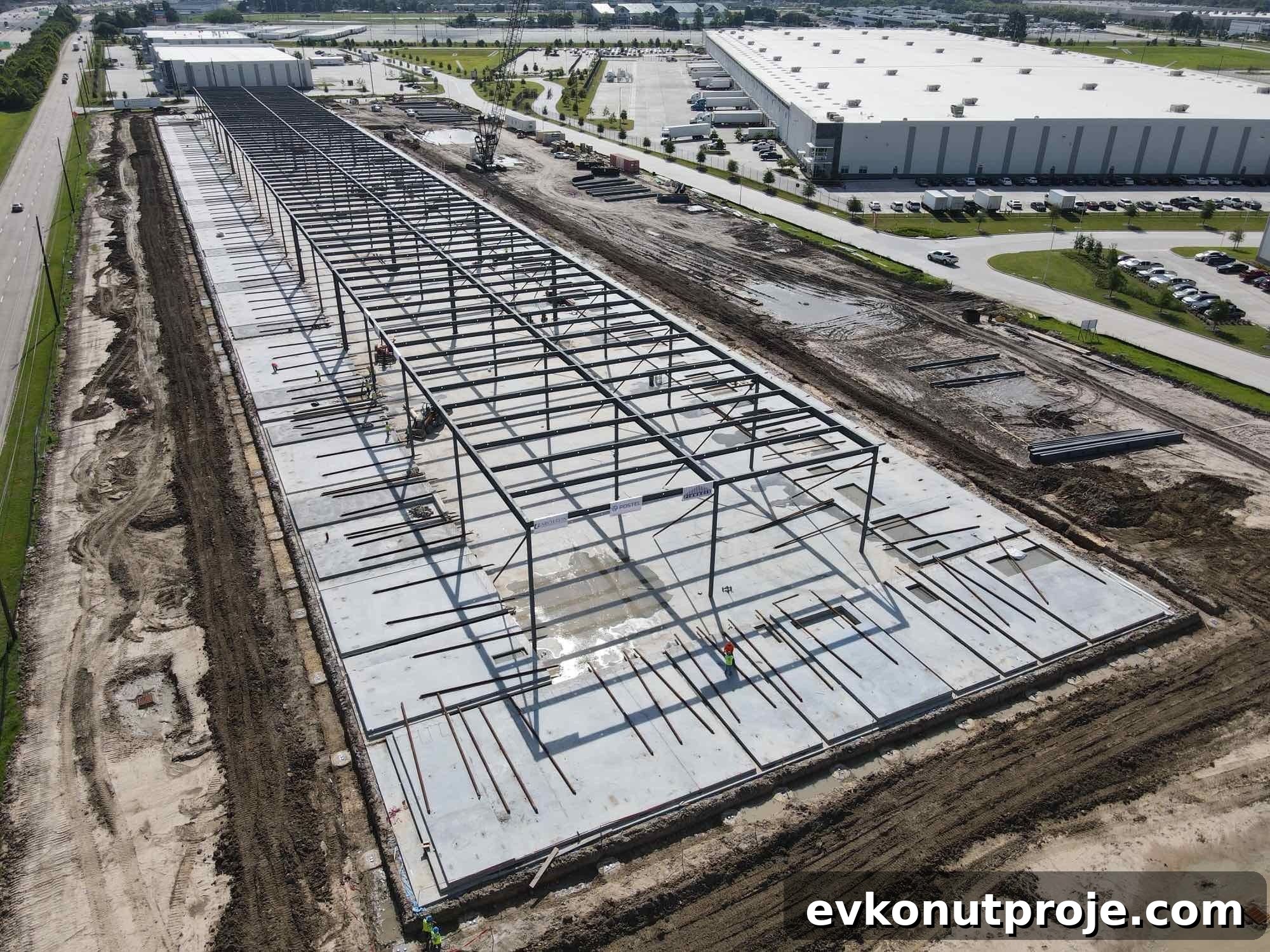
HOUSTON – (By Ralph Bivins, Realty News Report) – When a nationwide shortage of steel threatened to delay construction of a 220,000-square-foot industrial building in Hines’ Grand National Business Park in northwest Houston, general contractor Arch-Con Corp. pursued an alternative approach.
No Steel. No Girders. No Problem.
The challenge was a shortage of steel building materials across the country.
The solution was to rethink how warehouses are built.
As the nation experiences one of the largest warehouse construction booms in decades, industrial builders and developers from across the country have taken notice of this new method.
Arch-Con reports receiving a steady flow of calls, emails and inquiries. The scarcity of traditional building components is real, and demand for new warehouse space remains high in the e-commerce era.
Unexpectedly, the approach has inspired many imitators.
Who would have thought that a build-to-suit warehouse for Elliott Electric Supply — the eighth and final industrial building in Hines’ 110-acre Grand National Business Park along the Sam Houston Parkway near Gessner Road — would draw such attention? While this type of suburban warehouse isn’t the flashiest project in Hines’ portfolio, which includes The Galleria, a 75-story office tower, and numerous prominent international developments, the project has become notable for its construction innovation.
Scheduled for completion by the end of 2021, this Houston warehouse represents a turning point in construction methods.
The Birth of Innovation
Arch-Con and Hines assembled a collaborative team to address the central question: how do you construct an industrial building when steel joists and joist girders are unavailable? The team included Don Greive, founding principal of Pinnacle Structural Engineers, and Matt Postel of the Postel Companies, a steel fabricator.
Steel producers were operating at maximum capacity, leaving traditional steel framing components scarce — a shortage comparable to the pandemic-driven scarcity of everyday consumer goods earlier in the decade.
“We like to collaborate with the best in the business to find solutions whether short-term or long-term,” says Chris Heath, who oversees Arch-Con’s construction division. “This team didn’t just accept a challenge — they developed an industry-wide solution.”
The team moved away from conventional steel joists and joist girders used for roof support and instead employed wide-flange steel beams for framing. Wide-flange beams were more readily available on the market, allowing the project to move forward without lengthy delays.
Using this framing approach alongside a tilt-wall concrete design by Powers Brown Architecture, Arch-Con reports the building was also more economical to construct.
Houston – The Epicenter of Construction Innovation
Houston has a long history of construction innovation. The city was home to the Astrodome, the first covered stadium in the United States, which debuted on April 9, 1965. The Astrodome presented engineering challenges of unprecedented scale at the time: 600-foot column-free spans and ventilation systems capable of delivering chilled air across vast distances.
Those who underestimate Houston often overlook the city’s ability to adapt and innovate. Focusing solely on its problems misses an important reality: Houston’s track record shows a persistent capacity for practical invention and large-scale problem solving.
The city’s “can-do” spirit is not mere promotional rhetoric; it’s evident in projects large and small. In this case, what might have been a routine warehouse project became a laboratory for practical innovation — a demonstration of how collaboration and flexible thinking can solve supply constraints and keep projects on schedule.
Aug 9, 2021 Realty News Report Copyright 2021
Photo: Courtesy Arch-Con Corp.
For more about Texas real estate, see the book Houston 2020: America’s Boom Town – An Extreme Close Up by Ralph Bivins. Available on Amazon
Houston 2020 Ebook version
File: Building Construction History Arch-Con, Hines and Co.
File: Building Construction History Arch-Con, Hines Pinnacle Structural Engineers. Matt Postel of the Postel Companies. Powers Brown.