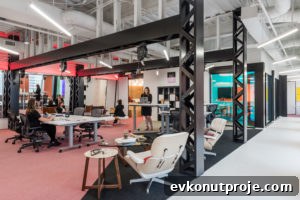
HOUSTON – (By Michelle Leigh Smith) – New thinking about the modern workplace hums on the 37th floor of one of Houston’s tallest buildings. That floor has been reimagined as DesignHive Houston — a kind of laboratory where concepts for tomorrow’s offices are on display.
At DesignHive you won’t find the traditional closed corner office with a heavy mahogany desk. Instead you’ll find fresh colors, contemporary trends and design strategies aimed at appealing to Millennials and the generations that follow.
Brookfield Properties commissioned four award-winning architecture firms to develop progressive, real-world workspace prototypes on the 37th floor of Brookfield’s 1600 Smith in downtown Houston. Rottet Studio, Gensler, Inventure Design and Ziegler Cooper Architects were each given the brief to create distinctive office environments, following the model of the original DesignHive in Los Angeles, completed in 2015.
A recent tour of the four suites prompts a rethink of how companies allocate space and how workplace design can support new users and new ways of working.
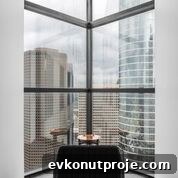
Rottet Studio carved out a contemplative corner designed for quiet moments. A single ebony chair faces two converging 14-foot glass panes, inviting occupants to pause, reflect and recharge.
“We think people need a mental break during the day and this is a quiet place where they can plan their day, or have a moment to recharge,” says Senior Associate Chris Evans. “This is my favorite place in our design.”
Picking a single favorite element within Rottet’s 5,305-square-foot suite is difficult; the space is filled with playful, creative details. Some windows are partially screened with lunar landscapes in the conference area. A vintage Galaxian Pac-Man arcade game sits against a wall. Designer Maksim Koloskov created a table that incorporates graphics from an old Space Invaders game. The suite also features artwork by Troy Standley from the Barbara Davis Gallery.
Rottet’s hospitality experience informs many of the comfort-oriented choices in the design. “With telecommuting and mobility, people often feel like guests in their own office,” Evans notes. Rottet has designed multiple hotels for Valencia Group, including the Hotel Alessandra at Midway Companies’ GreenStreet complex in downtown Houston.
“While traditional corporate layouts often have a single lobby per floor, we introduced two separate lobbies to foster a sense of equality across the workplace,” Evans adds. “We wanted each area to bring in natural light. Light changes people’s perception of space and its value.”
Each of the four suites includes a “hearth as home” element — a coffee bar or kitchenette placed prominently to create a welcoming, domestic atmosphere. At Rottet the coffee bar sits near the front. Gensler’s entry uses soft chartreuse and neutral tones to set a relaxed tone, while Ziegler Cooper’s reception concept encourages interaction; its front door features a dichroic screen, an aesthetic nod to Houston’s historical ties to energy and fuel technologies.
“The needs of the modern workforce evolve every day, so we designed a highly flexible, adaptive environment,” says Manuel Navarro, Design Director at Ziegler Cooper. “Our Assemblage concept — a gathering of unrelated objects — reflects the mix of people, cultures, ages and work modes using the space. Technology enables greater mobility, so we created multiple destinations and workstations to move people away from the typical desk-and-chair setup.”
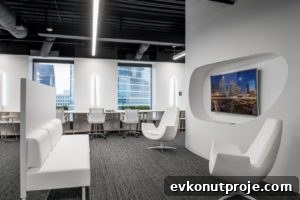
Inventure Design’s Office of the Future places the kitchen at the far end and uses writable walls and cabinets to support spontaneous collaboration. “It’s time to move out of cramped, uninspiring office environments into vibrant, technologically advanced spaces,” says Principal Jim O’Neill. “Many offices can operate with fewer on-site staff, and those present often spend hours in front of screens. As workforce dynamics change, companies must adapt their workplaces to promote a more advanced culture.”
For Ziegler Cooper’s Assemblage-inspired 3,730-square-foot suite, Navarro worked within a modest budget and used flexible, cabled hanging electrical plugs so outlets can be repositioned as needs change. “Assemblage guided our staging,” says project designer Laura Nagala. The entry features a fawn-colored horned elk head with braided accents and a fluorescent orange chain above a sofa and a zebra-effect rug sourced from Navarro’s home. Playful touches include a Fisher-Price turntable, a pink pineapple and strip lighting from a big-box store.
The palette includes several shades of red and what Nagala calls “millennial pink.” “Pink was part of many of our childhoods — Easy-Bake ovens and Barbie houses — and it’s interesting to see it evolve into more refined workplace settings,” she says.
Small details amplify that palette: bottles of Topo Chico Twist of Grapefruit and mineral water line a wall, recalling the red, pink and white color blocks of architect Luis Barragán’s Casa Giraldi in Mexico City, built in 1947.
“This (1600 Smith) is an older building,” Nagala explains. “Unlike more recent plate-glass towers, its columns and proportions remind us of Barragán’s work.”
Inventure Design places rosemary planters at each window along the outer wall of its central workspace. Desks with flowing curves replace hard-edged furniture throughout the 3,576-square-foot suite, reflecting a preference for organic forms. O’Neill believes work should be enjoyable; he keeps an arsenal of Nerf guns for a daily 3 p.m. skirmish to release tension. Among Inventure’s other projects are Freeport LNG’s top floor at Three Allen Center and law offices for Gibbs & Brun at 1100 Louisiana.
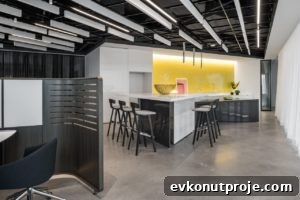
Gensler’s suite is grounded in research on activity-based work settings, personal work preferences and the reality that businesses must quickly adapt physical space to evolving business models and client needs.
“Technology allows people to work from anywhere, which increases mobility,” says Gensler principal Dean Strombom. “Our research shows people are at their desks only about half the time, so the space could support roughly 70 people even if fewer are seated simultaneously.”
Gensler’s 4,105-square-foot design features no assigned seating. Instead the layout defines distinct zones: entries, gathering areas, dining, collaboration and social spaces, quiet zones and storage. Specialized lighting, emerging wall systems and furniture that supports varied postures offer occupants a range of choices for where and how to work. “Rather than building permanent walls, the suite dissolves barriers to open the floor and enhance flexibility for different work modes,” says Gensler Senior Associate and Design Director Yishio Kuo. “Moveable elements like curtain drapery let users curate their environment based on immediate needs.”
O’Donnell Snider Construction partnered with Brookfield to build the DesignHive, which Brookfield fully funded. After the public reveal, each of the four suites will be available for lease through the property’s leasing agent.
May 16, 2017 Realty News Report Copyright 2017