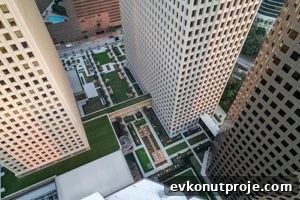
HOUSTON – With the arrival of April, construction fencing returned to Allen Center as Brookfield Properties begins Phase II of its multi-year redevelopment, now focusing on Two and Three Allen Center.
The ongoing initiative, titled “Reimaging Allen Center,” is a multi-phased transformation intended to modernize the campus and improve the experience for office tenants, visitors and pedestrians. Project materials indicate Phase II is scheduled for completion in late 2020 and continues the property’s shift toward a more open, accessible and amenity-rich downtown destination.
Travis Overall, executive vice president and head of Brookfield’s Texas region, describes the strategy behind the program as holistic: the work blends street-level upgrades, expanded interior and exterior gathering spaces, enhanced natural light in lobby areas, and expanded retail opportunities to better serve tenants and the surrounding neighborhood.
Phase I of the reimagining, completed in 2017, focused on One Allen Center, a 34-story, roughly 1 million square-foot office tower that had last received major updates in 1992. That phase introduced a two-story glass façade, a re-clad sky bridge to Two Allen Center, and The Acre—a new greenspace designed for informal gatherings, programmed events and a stronger street-level connection. Crucially, the first phase removed a berm and redundant skybridge that previously separated the campus from Smith Street, helping knit the development back into downtown Houston.
Phase II builds on those changes to align the campus with contemporary tenant expectations and the evolving office experience. Two Allen Center’s redesign will include a two-story lobby, a second-floor terrace overlooking The Acre, and refreshed retail bays. Plans also call for a striking glass-box restaurant expected to open this fall. Like its neighbor, Two Allen Center offers about 1 million square feet of office space across 36 stories.
Three Allen Center will receive a renovated lobby and new tenant amenities including showers and lockers—amenities that support modern commuting patterns and onsite wellness. The 50-story tower, completed in 1980, contains approximately 1.2 million square feet of office space. As part of the second phase, a new sky bridge will reconnect the two towers and elevator lobbies in both buildings will be updated to improve circulation and the tenant experience.
“The reimagining of Allen Center has always been planned as a multi-phase project,” Overall said. “The success of Phase I at One Allen Center and The Acre demonstrated how impactful these improvements can be and gave us the confidence to move forward with upgrades to Two and Three Allen Center. When completed, Allen Center will be a top-tier office environment offering a variety of restaurant and retail options, upgraded lobbies, tenant lounges and collaborative spaces, plus a wonderful outdoor gathering place.”
The Phase II design and construction team includes architects Morrison Dilworth + Walls and PDR Corp., with Tellepsen serving as construction contractor and OJB Landscape Architecture providing landscape design—the same firm that designed The Acre during Phase I. Brookfield has not disclosed the cost of Phase II; Phase I was reported at $48.5 million.
On the campus fringe, the former DoubleTree Hotel by Hilton is undergoing a comprehensive overhaul and rebranding as The C. Baldwin. The hotel renovation includes redesigned guestrooms and public spaces, a new restaurant, an updated greenspace and roughly 14,000 square feet of meeting and event facilities. The repositioned property is scheduled to relaunch this summer. The new name honors Charlotte Baldwin Allen, whose dowry helped finance Houston’s founding by the Allen brothers; she is commonly referred to as the Mother of Houston.
Regardless of the hotel’s new identity, it remains an integral part of Allen Center, which spans a seven-acre site on the west side of downtown Houston. Brookfield has also started a separate transformation at Houston Center on the east side of downtown, applying similar design principles—bringing more light, open spaces and street-level amenities to large, formerly monolithic office complexes to make them more inviting for workers and passersby.