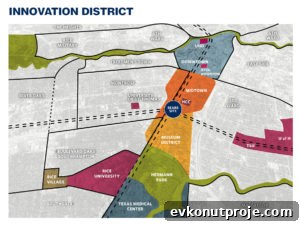
HOUSTON – Rice University has unveiled plans to transform the former Sears store site in Midtown into a new innovation district designed to attract technology startups, entrepreneurs and venture capital.
Rice owns 9.4 acres at the Midtown location, including the four-story Sears building at 4201 Main St., an adjacent Fiesta store, surface parking lots and additional parcels around Wheeler Street, Fannin and San Jacinto.
Inside the historic Sears building on Thursday, Rice University President David Leebron stood beside Houston’s first escalator to announce a global technology center intended to help position Houston as a destination for technology companies and entrepreneurial growth. Mayor Sylvester Turner joined him at the announcement.
“The redevelopment of the building will respect its historic character while making the modifications required to create dynamic space for creative companies in the innovation ecosystem,” Leebron said.
Leebron added that the innovation district will leverage the region’s economic strengths and aim to elevate Houston as a global leader in data science and digital technologies, focusing on energy, industrial, health care and logistics sectors. “We intend to attract talent and support all stages of the innovation lifecycle with state-of-the-art resources: incubators and accelerators, classroom and event space, prototyping facilities, networking opportunities and entrepreneurship training,” he said.
Houston-based developer Hines will lead the redevelopment of the Sears building, which originally opened in 1939 and closed recently. Architectural firms Gensler and James Carpenter are involved in the project design.
The 190,000-square-foot Sears building will be converted into a hub to unite the area’s entrepreneurial, corporate and academic communities through collaborative spaces and programs. The initial phase of redevelopment is expected to be completed within two years.
The announcement follows Houston’s unsuccessful bid to host Amazon’s HQ2, a high-profile contest that would have brought a proposed $5 billion facility and tens of thousands of jobs. Houston was the largest city not included among Amazon’s 20 finalists.
Asked what lessons the city took from that outcome, Mayor Turner responded with humor and determination: “I’ve so much forgotten about that. Seriously, the City of Houston is ready to play ball in a major, major way. We are putting forth the best effort to prepare for our future. We didn’t wait. We are here today – this is the first day of a brand new Houston.”
Nearby, a large homeless encampment has formed beneath the Highway 59 overpass. Mayor Turner said a residential initiative offering meals and housing for residents of that encampment will be announced soon.
“Houston is always transforming,” Turner said. “We went from a cotton, rice and rail hub to the energy capital of the world, a global center for biomedical breakthroughs and an enviable model for inclusion for people and cultures from everywhere. Thanks to Rice and our many other partners in the innovation district being announced today, the city is poised to make yet another dramatic leap into the future.”
Leebron emphasized the collaborative nature of the project: “This will be an innovation and incubation facility for all Houston. Rice owns the property, but the enterprise will be a collaborative mix of many different participants and activities.”
Rice Management Company completed a long-running transaction to consolidate control of the property by buying out the remaining years of a 99-year lease previously held by Sears, a deal facilitated over more than five years by Investment Director Alan Arnold.
The innovation district will blend commercial uses with housing, dining and entertainment, prominent public spaces and modern infrastructure, Leebron said. The surrounding neighborhoods’ rich culture will be celebrated to create an eclectic, engaging streetscape that integrates historic elements with new development and reflects Houston’s diversity.
Plans include classrooms and creative gallery space with abundant natural light, supporting both educational programming and public exhibitions.
“The many participants already committed to this vision typify Houston’s collective spirit of inclusivity and entrepreneurship, and we welcome people and organizations who can contribute to its overarching mission,” Leebron said.
The site, held by Rice Management Company as part of the university’s endowment, sits close to the METRORail Red Line and is central to downtown, the Museum District and the Texas Medical Center (TMC). The TMC has pledged support for the project, alongside the Greater Houston Partnership (GHP) and Houston Exponential (HX).
Leebron noted that the location lies at the center of Houston’s higher education institutions, with most campuses within a three-mile radius. The University of Houston, University of Houston–Downtown, Texas Southern University, University of St. Thomas, Houston Christian University, South Texas College of Law Houston, Houston Community College and Lone Star College have all expressed support and interest in participating. The Texas Medical Center plans to locate its digital initiative within the facility once completed.
“There’s a thriving innovation community here in Houston, but it’s spread out across the city,” said Bill McKeon, president and CEO of the Texas Medical Center. “This site will serve as a cornerstone of the Houston innovation district, which will finally connect those hubs.”
Rice developed the plan in close collaboration with the Greater Houston Partnership, Houston Exponential and Station Houston, the region’s tech innovation hub focused on digital technologies. Station Houston will operate as an incubator and program manager and will pursue three primary objectives: connecting ecosystem participants to drive high-impact collaborations; supporting entrepreneurs with programs, workshops and events; and partnering with academic institutions and others to develop and integrate Houston’s digital workforce.
“Transformative,” said John Reale Jr., co-founder and CEO of Station Houston, describing the project. “Today we take a major step forward toward our shared vision of transforming Houston into a world-leading tech innovation and entrepreneurship ecosystem. This could not be possible without the ongoing collaboration of Houston’s academic institutions, corporations, major institutions, investors and entrepreneurs. We applaud Rice for its vision and commitment in leading this community effort.”
“It is clear Houston needs to take some aggressive steps on the innovation economy,” added Bill Fulton, director of the Kinder Institute for Urban Research at Rice University. He noted that successful innovation centers typically involve strong partnerships between cities and major universities.
University and civic leaders, including UH Chancellor Renu Khator, METRO Chair Carrin Patman, and South Texas College of Law Dean Donald Guter, attended the event to show their support.
One critical design consideration will be improved transit access. Edwin Friedrichs, senior principal at Walter P. Moore, warned that street-level access could create traffic congestion, so Rice is working with HR&A Advisors to explore grade-separated transit options to reduce traffic impacts, according to Rice spokesman Greg Marshall.
April 12, 2018 Realty News Report Copyright 2018