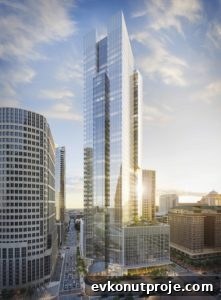
(REALTY NEWS REPORT) – Designed to attract and retain top talent, Texas Tower is rising in downtown Houston. The 47-story project from Hines and Canada’s Ivanhoé Cambridge offers greenscaped terrace roof decks, a public garden on level 12, multiple food and beverage options and abundant communal spaces for networking.
Designed by Pelli Clarke Pelli and scheduled to open in late 2021, Texas Tower features flexible floor plates, tenant-focused amenities and advanced health-forward systems. “Every building we build is not only a product but a laboratory,” said John Mooz, senior managing director for Hines in the Houston/Austin/San Antonio market, during the National Association of Real Estate Editors’ (NAREE) Annual Real Estate Journalism Conference at the Hyatt Regency Austin. “When we built 609 Main in Texas, we learned that people wanted more access to natural light and more green space. Texas Tower delivers both.”
Mooz added that Hines will soon introduce a global workforce platform, partnering with two best-in-class operators to provide the kinds of space clients seek. “There will be more to come on that,” he said.
Mooz spoke on the NAREE panel “The Future of Work: Evolving Office Towers,” joined by Kristopher Harman, vice president of Woodbine Development; Jennifer Mejia, Austin studio director for global design firm Gensler; and Brian Harrington, chief experience officer for CBRE’s Hana, a unit that helps institutional property owners meet the growing need for flexible office solutions.
Moderated by Candace Carlisle of CoStar News, the panel agreed that many workers today prefer environments that include a coworking component. Buildings that lack coworking elements risk falling behind in attracting occupants.
“There is no one-size-fits-all office design,” Mejia said. Demand is rising for more open, adaptable workspaces that encourage employees to come in and collaborate. “One challenge we see is a lack of built-in flexibility in many older buildings. Clients want adaptable spaces, not just static desks,” she noted.
Mejia highlighted Gensler’s work on Yeti’s global headquarters in Austin, which uses honest, plain materials and outdoor-inspired colors. The space includes a fire pit, an outdoor stage/work area, a brew house and other elements that avoid a traditional corporate feel.
Harrington emphasized that flexible office space is a lasting trend. “Flexible space is here to stay and will represent over 10% of commercial real estate in the coming years,” he said. “We believe we’ve developed a solution set tailored to high-growth companies.”
He pointed to Hana’s first project, PwC Tower at Park District in Dallas, a development by MetLife Investment Management and Trammell Crow Company, which is expected to open this year.
Developers are also integrating lifestyle amenities into office environments, from on-site chefs to fitness centers, said Kristopher Harman of Woodbine. “Our background is hospitality, and we’re exploring how hotel-like elements can enhance office buildings,” he explained.
In the Los Angeles area, where many clients produce creative content, Woodbine is renovating a DoubleTree hotel and adding adjacent office space for creative tenants. “We converted the hotel’s parking lot into entitled creative office land,” Harman said. Once the hotel renovation and the new building are complete, employees will be able to use the hotel’s fitness center and media spaces, and reserve conference rooms—creating a seamless experience between the hotel and office facilities.
While demand for flexible office space will continue to grow, panelists do not expect it to dominate the market. “I think about 10% of office space will be flexible,” Harrington said. “It’s not going to tip everything over—there will always be traditional long-term leases.”
June 28, 2019 Realty News Report Copyright 2019