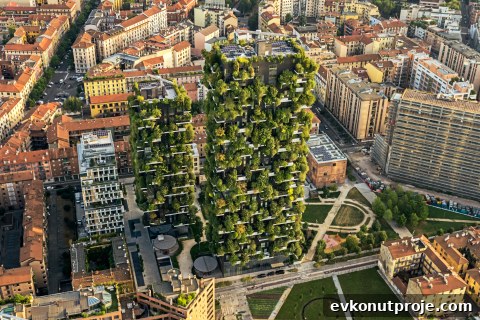
MILAN – (Realty News Report) — Architect and urbanist Stefano Boeri, founder of Stefano Boeri Architetti in Milan, has outlined a comprehensive vision for Urban Forestry that emphasizes integrating planted roofs and living walls into the built environment. As Earth Day 2021 approaches, Realty News Report publishes the following statement from Boeri:
“We have entered a new phase of human history in which cities and forests will form a renewed alliance. Historically treated as opposing realms—cities as the ultimate expression of human artifice and forests as emblematic of naturalness—these two environments must now be brought together. Trees and woods should no longer be limited to decorative roles or confined to protected areas; they must become an integral part of the daily lives of millions of urban residents. Protecting existing forests, afforesting cities, and developing new Forest-Cities are urgent, interconnected challenges we must tackle now if we are to slow the progression of climate change.”
Stefano Boeri, the architect behind Milan’s internationally recognized Vertical Forest, has repeatedly promoted the concept of Urban Forestry worldwide. He has participated in numerous international working groups and committees, from Milan’s Urban Forestry initiatives to the proposal for a Great Green Wall of Cities presented at the United Nations Climate Action Summit. That proposal aims to create 500,000 hectares of new urban forests and 300,000 hectares of natural forests near approximately 90 cities stretching from Africa to Central Asia, to be established and maintained by 2030.
Climate change is increasing urban exposure to droughts, heat waves, extreme winds, floods and landslides, affecting hundreds of millions of people. Nature-based and forest-based solutions help cities adapt by cooling urban areas, protecting soils, preserving watersheds and supplying forest products to city dwellers. Combining technological innovation with locally adapted, climate-appropriate nature-based strategies enables cities and communities to mitigate climate impacts while delivering long-term social, environmental and economic benefits.
With cities globally responsible for roughly 70% of CO2 emissions and forests absorbing around 40% of atmospheric CO2, expanding tree cover within and around urban centers would significantly boost urban resilience and reduce CO2 levels through enhanced plant photosynthesis.
Within the framework of the Urban Forestry vision, Boeri’s international team advocates specific design strategies—such as planted roofs and living walls—that offer ambitious, practical solutions for greening metropolises, even in arid or hot climates. Stefano Boeri Architetti’s research department leads international debates and advances in green, sustainable urban design across Europe and many other countries. Their work positions them at the forefront of ecological and ecosystem-based urban regeneration, championing mixed-use, nature-based design projects that marry academic research with practical application.
What about the world’s most arid and torrid regions, such as Saudi Arabia and Riyadh? Greening these environments is complex, but proven methodologies and techniques can deliver strong results. For example, Stefano Boeri Architetti’s Vertical Forest project in Cairo demonstrates this approach: towers 30 meters tall and wide that will host about 350 trees and more than 14,000 shrubs and perennials across roughly 100 species—representing about one-third of the genera found in Greater Cairo. The total planted area will exceed 3,600 square meters, equivalent to the building footprint. These three new vertical forests—the first in Africa—will be energy self-sufficient, absorb about seven tons of carbon dioxide per year, and produce approximately eight tons of oxygen annually.
Effective water management is essential to any green infrastructure, particularly in arid environments or when greening artificial structures. Carefully designed systems for collecting, storing, using and managing water resources can determine the success of nature-based interventions. Stefano Boeri Architetti’s green implementation strategies include:
- Biodiversity-focused xerophytic green roofs planted with native, drought-adapted species, modeled on rocky microhabitats to minimize maintenance and reduce or eliminate irrigation need;
- Biodiverse vertical green walls supporting a wide range of vegetation—from trees to shrubs and perennials—that can use treated greywater from the building as a primary water source;
- Bioactive green roofs and walls that assist in greywater remediation, where plant systems contribute to the final phase of water recycling;
- Functional and structural diversity in plant cover—roughness, complexity and eco-physiological variety—that enhances benefits to the water cycle, gas exchange, and soil health.
These systems form a resilient, durable green infrastructure that mitigates urban heat islands, improves thermal insulation for façades and roofs, reduces stormwater runoff, and helps lower air pollution. Living roofs and walls become active components of a city’s landscape infrastructure.
Choosing native plants for roofs, walls and landscape areas supports local wildlife and creates healthier environments for residents and communities. Conventional lawns and bark-mulched landscapes often depend on large quantities of artificial fertilizers and chemical pesticides; in fact, suburban lawns can require far more pesticides per acre than farmland. Replacing those lawns with native plantings reduces chemical inputs and contributes to climate mitigation.
Nature-based solutions support sustainable urbanization, restore degraded ecosystems, improve climate adaptation and mitigation, and strengthen disaster risk management and resilience. By reshaping urban environments, these approaches can also improve inclusivity, equity and livability: they can revitalize neglected districts, enhance physical and mental health, reduce violence and ease social tensions by fostering stronger social cohesion—benefits that are especially important for vulnerable groups such as children, older adults and low-income populations.
(Statement from Stefano Boeri Architetti of Milan.)
April 20, 2021 Realty News Report Copyright 2021
Rendering Credit: Stefano Boeri Architetti
For more about Texas real estate, check out the book Houston 2020: America’s Boom Town – An Extreme Close Up by Ralph Bivins. Available on Amazon
File: The Urban Forestry Solution for Sustainability
Earth Day Note: New timber office tower announced by Hines in Fort Lauderdale.