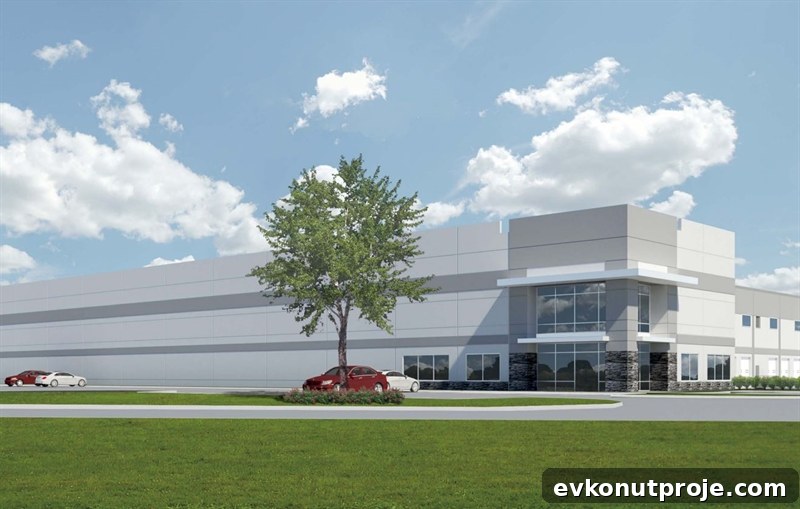
HOUSTON – (By Dale King, Realty News Report) – Houston is a major player in the “big box” warehouse industry, according to a recent study by real estate services firm CBRE.
CBRE’s report identifies Houston’s logistics market as one of the most attractive investment targets in the South-Central United States for both domestic institutional capital and foreign investors. Annual industrial sales in the Houston area reached $1.2 billion in 2018, $900 million in 2019 and $1.7 billion in 2020, the firm reported.
Construction Boom
In 2020, more than 12 million square feet of new warehouse space was completed in Houston, making it one of the nation’s busiest locations for warehouse construction. The city’s pro-business climate, favorable real estate conditions and strong growth helped drive its expanding industrial market, said Peter Mainguy, senior managing partner at CBRE.

Mainguy noted Houston’s consistent resilience: the region has sustained population and job growth despite economic downturns, natural disasters and the pandemic. He also said recent demand for warehouse space has been driven by e-commerce, logistics and building-supply companies.
The surge in construction helped push the direct vacancy rate higher, to 7.4 percent. Transaction volume reached 4.4 million square feet in 2020, an increase of 6.8 percent year-over-year.
The CBRE study, titled “North American Industrial Big Box Report and Outlook,” found the industrial and logistics sector across the hemisphere enjoyed its strongest year on record in 2020 despite a severe economic downturn caused by the pandemic. Occupiers moved into facilities rapidly to serve a growing online consumer base and increased safety stock to avoid the inventory disruptions of the prior year.
While all types of industrial real estate performed well in 2020, big-box facilities—defined by the report as warehouses or distribution centers of 200,000 square feet or larger—outperformed the rest. Occupiers across many industries expanded their presence in big-box properties to serve rising populations, gain proximity to logistics hubs and take advantage of government incentives.
Houston’s central location is a key advantage: more than seven million people live within 50 miles of the market core, and population is projected to grow by 9.7 percent over the next five years.
The Houston Workforce
Within a 250-mile radius of Houston’s core nearly 26 million people live, with expected growth of 7.9 percent. The 18-to-34 age group represents 35 percent of the population, a favorable demographic for employers seeking warehouse labor.
CBRE’s Labor Analytics indicates Houston’s warehouse labor pool totals about 92,437 workers and is expected to grow roughly 10 percent over the next decade, providing ample labor for the expanding big-box market. Despite workforce growth, average wages for non-supervisory warehouse personnel remain about 3.4 percent below the national average.
The report highlights Houston’s robust distribution infrastructure. Its central location allows relatively easy access to both U.S. coasts. The Port of Houston is the largest container port on the Gulf Coast and has been instrumental in the city’s international trade growth. Houston also hosts the nation’s largest petrochemical complex and the world’s second-largest, and is connected by major carrier services to global markets. The shipping channel intersects the busy Gulf Intracoastal Waterway, supporting substantial barge traffic.
CBRE also emphasizes Houston’s extensive highway network, which integrates well with airports, deep-water seaports and mainline railroads. The city sits at the crossroads of Interstates 10, 45 and 69—the latter often called the “NAFTA superhighway” linking Canada, the U.S. industrial Midwest, Texas and Mexico.
Looking forward, Houston ranks fourth among the 22 markets analyzed in the report for warehouse space under construction. About 31.1 million square feet are currently being built in the market, with approximately 46.5 percent of that space already leased.
Dallas-Fort Worth follows closely in construction activity and ranks sixth among the 22 markets. D-FW has 11.1 million square feet under construction, with roughly 20 percent leased. Top markets by under-construction volume include South New Jersey/East Pennsylvania, Chicago, Atlanta and Memphis.
The CBRE report notes that the Dallas-Fort Worth region also benefits from a central location, two major logistics ports—the Alliance Global Logistics Hub and the International Inland Port of Dallas—and the convergence of three major rail networks (Union Pacific, BNSF and Kansas City Southern). By rail, about 98 percent of the U.S. market can be reached within 48 hours. D-FW International Airport ranks among the nation’s top cargo hubs and can reportedly double cargo operations within its current footprint, allowing air access to all major U.S. markets in under four hours.
D-FW’s logistics position has been strengthened by economic incentives: the region recorded 73 incentive deals over five years totaling more than $606 million, equating to about $11,541 per new job in the Dallas metro area, according to Wavteq. “D-FW continues to outperform expectations and possesses some of the healthiest industrial market fundamentals and sales activity in the U.S.,” said CBRE Vice Chairman Randy Baird, a report contributor.
Nationally, CBRE noted U.S. big-box sales volume in the first quarter of 2020 totaled $1.1 billion, more than a 500 percent increase over Q1 2019. Sales activity slowed sharply in Q2 as the pandemic took hold, followed by $658 million in Q3 and $1.2 billion in Q4.
April 1, 2021 Realty News Report Copyright 2021
For more about Houston development, see the book Houston 2020: America’s Boom Town – An Extreme Close Up by Ralph Bivins.
Image: Rendering of new Houston project. Courtesy: Trammell Crow