Workplace 360: CBRE’s Williams Tower Offices Reveal Future Trends
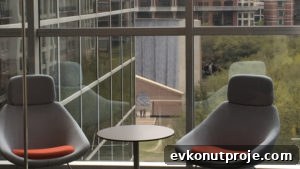
CBRE huddle space. Photo: C. Lescalleet
HOUSTON – (By Cynthia Lescalleet, Realty News Report) – After consolidating its local offices and moving into the Workplace360 environment at Williams Tower, CBRE Houston’s 297 employees now have a dozen distinct, sleek work settings to choose from each day. As their tasks shift during the day, so can the environment they work in.
This flexible, activity-based layout, supported by upgraded technology and new workplace behaviors, is designed to promote collaboration, efficiency, productivity and employee well-being—the hallmarks of “office of the future” design.
“Welcome to the future,” said Cody Armbrister, senior managing director, during a press tour of the new space in Williams Tower, the 64-story Hines building next to the Galleria.
Cody Armbrister
The office opened a month ago after 28 months of Workspace360 planning and a carefully executed move over President’s Day weekend. Employees returned to an open-plan layout organized into color-coded “neighborhoods” that cluster related business functions. A staffed welcome desk on the main floor serves as the hub; hospitality-trained concierges provide support services for employees and visitors.
Work options include adjustable-height desks with oversized curved monitors, “office for a day” setups, hotel-like rooms for small client or team meetings, and fully equipped presentation-ready conference rooms—all available by reservation.
A centerpiece feature is the “Liquid Galaxy” room: a dramatic wall of seven large, interconnected screens that display CBRE’s extensive market maps and data. The system enables immersive virtual tours of the city, close-ups of property listings, and even views of rooftops and traffic patterns when needed.
The variety of settings supports the full spectrum of tasks—quiet focus, concentrated reflection, or energetic collaboration. To balance interaction and concentration, the space uses a subtle sound-masking system that blends with the office ambience.
Under this modern approach there are no assigned private offices or permanent desktops—workspace is address-free for everyone, regardless of title or role.
Mark Taylor
Managing Director Mark Taylor says he typically changes work locations three times a day, selecting spaces that fit the task at hand. He enjoys the greater proximity-based interaction with colleagues—“discussions by proximity,” as he calls it—and finds the experience energizing and liberating.
Every employee gets an assigned locker and a lockable lateral file drawer. Each workstation includes a stocked drawer of office essentials—highlighters, tissues and the basics. Shared shelving displays team awards and achievements.
Technology supports mobile work: the phone system follows the user’s location, and networked printers authenticate and follow users via a small chip on the office key. That reduces unnecessary printing, protects privacy, and works across CBRE offices.
Personal items and family photos stayed at home; temporary personalized graphics appear when users log into the system. Before the move, CBRE hosted purge events and contests that eliminated or digitized roughly seven million pages stored in 1,800 file drawers. Thanks to cloud storage, the physical archive now totals just under 400 drawers. The oldest document found during the purge was a 1969 letter.
TAKING ITS OWN ADVICE
Workstation with local wallpaper. C. Lescalleet
CBRE Houston is the latest office to adopt the firm’s Workplace360 program, which has transformed about 50 CBRE workplaces worldwide since 2011. The initiative began when the company faced a wave of lease expirations and chose to rethink space use and operational efficiency—precisely the guidance its Workplace team offers to clients. (Workplace360 is the name CBRE uses for its internal transformations.)
The Houston project is CBRE’s largest Workplace360 conversion to date, totaling 77,000 square feet.
Each rollout informs the next, Armbrister said. In Houston, compatible business functions were deliberately placed near one another to boost synergy. Internal studies showed employees were at their assigned desks only about 48 percent of the time, revealing opportunities to repurpose space more effectively.
The relocation consolidated CBRE Houston’s operations from its downtown Bank of America Center office and from offices at 2700 Post Oak Blvd into a single location. The redesign accommodated all staff while reducing the company’s footprint by about 22 percent, yielding savings in rent, energy use, emissions and water consumption. The office is pursuing LEED certification.
Some of those savings were reinvested into the technology that powers the new workplace, Armbrister said, though he declined to disclose financial specifics.
Despite a smaller overall footprint, the layout allows room for future growth. CBRE now occupies parts of Williams Tower’s second and fourth floors and the entire fifth floor, a former trading room that offered a large floor plate, high ceilings and expansive views.
Renovating that sizable floor required stripping away nearly 40 years of layered finishes to achieve a level floor and reveal mechanical surprises above the ceiling—but the result gained a dramatic space with above-standard ceiling heights. A minimalist new staircase connects levels, creating both practical circulation and a striking design feature.
The design organizes the office into north, south, east and west “neighborhoods,” each reflecting Houston’s geography through custom pop-art wallpapers that depict local icons from the Texas Medical Center, the East End industrial district or Post Oak. Conference rooms are named by employees and display Houston-themed artwork. Color-coded carpet and arcade elements help define areas by business function.
Each neighborhood includes a coffee station stocked with complimentary, intentionally healthy snacks. Wellness rooms—fully private with doors—are integrated into the floor plan alongside glass-walled temporary offices, work booths and communal gathering areas.
CBRE Houston partnered with Gensler on the redesign. Gensler has been a leader in “office of the future” design across many industries, from energy to airlines to media.
Armbrister said CBRE Workplace works with clients to identify ways to reduce or reallocate costs, better manage resources, and improve employee engagement. With Workplace360, CBRE became its own client, putting its recommendations into practice.
CBRE monitors employee response to the new environment at six weeks and six months. Internal surveys of offices that previously transitioned to Workplace360 show strong results:
93 percent would not return to a traditional office
79 percent feel more productive
83 percent agree they can find space for private or focused work
94 percent agree they can more easily collaborate
Next on the Workplace360 schedule is CBRE Atlanta.