Commercial Real Estate Market Update — June 5, 2018
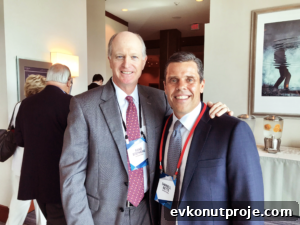
Rand Stephens, Darrell Betts, Avison Young
HOUSTON – (By Michelle Leigh Smith, Realty News Report) – When Welcome Wilson Sr. raised the funds for his first development, Jamaica Beach in Galveston, oil sold for $2 a barrel, the Texas Railroad Commission influenced global oil prices, and Dwight D. Eisenhower was president.
“I was always taught to respect my elders and now I only have one left – Gerald Hines and he’s 91,” says Wilson Sr., now 90, as he opened the Bisnow/HAR Commercial State of the Market macro conversation for 300 commercial real estate professionals at the Westin Memorial City. He shared recollections of his early years in Houston real estate.
Like Jesse H. Jones before him, Wilson Sr. urged developers to confront problems directly. “My father wanted my brother and I to move here in 1946 because he believed Houston would be the business capital of the world. At that time, Mr. Jones owned seven of nine hotels, eight of twelve office buildings, the largest bank—the National Bank of Commerce—the biggest newspaper, the Houston Chronicle, and the largest radio station, KTRH, headquartered at the Rice Hotel,” he recalls.
Welcome Wilson Jr. quizzed his father about Houston’s booming real estate years. Wilson Sr. graduated from the University of Houston in 1947.
“I was going to become an oilman and went to work for R.E. ‘Bob’ Smith,” he says. “Judge Roy Hofheinz appointed Bob director of civil defense and I served as an assistant to the mayor so I could make speeches when the mayor couldn’t attend. Bob told me the independent oil business was over—an independent couldn’t raise $40,000–$50,000 to drill a well—so I needed to move into real estate. He was the largest real estate owner in Harris County. He owned land just west of River Oaks, what’s now both sides of the West Loop and Westheimer, and land further out that became five miles of the West Belt on both sides.”
Wilson later developed 1,200 lots on Tiki Island, selling them for $18,500 each.
“My father was right—business boomed in the late 1950s, so with Walter Mischer Sr.’s help, I entered the apartment business,” he says. “We didn’t call it multifamily then. Houston has long been a city of opportunity because of people like Jesse Jones, Bob Smith and Walter Mischer. Then we built shopping centers and hotels. When Marriott had five hotels, I developed No. 6 near the Astrodome. Today Marriott operates thousands worldwide. We also built three office buildings downtown.”
Darrell Betts, Principal of the Capital Markets Group at Avison Young, said it was an honor to share the stage with the Wilsons. “I think Houston will be OK,” Betts said. “Over the last three years and looking ahead to the next two, more than $50 billion will be invested in infrastructure along the Houston Ship Channel, creating roughly 50,000 jobs. Viewed that way, we’re in a strong position. Fifty billion dollars is the equivalent of many major company expansions—there will be a significant influx of firms supporting refinery projects.”
“Houston is very pro-business,” Betts added. “By 2050, the region could reach 22 million residents. We’ll continue to diversify.”
Betts spoke on a panel that outlined a five-year vision for Houston alongside Larry Johnson, President of Johnson Development LLC; Andrew Lusk, Head of Acquisitions at Lionstone Investments; and Simmi Jaggi, Senior VP at JLL. The discussion was moderated by Randy Elkins, Managing Director at American Trust Title. HAR’s commercial division and Bisnow hosted the annual event.
Jaggi pointed to Houston’s low cost of living and the absence of traditional zoning as competitive advantages.
“Houston welcomes people regardless of where they come from; if you can contribute, you are welcome,” said Larry Johnson, founder and president of Johnson Development. “In homebuilding, Houston ranks second in the nation, behind Dallas.”
“The elephant in the room is interest rates,” Betts observed. “They were 2.94 percent this morning. My dad always said if you could predict rates, you could relax on a beach and fly around in a Gulfstream.”
As the global energy capital, Houston has historically attracted major oil and gas firms such as Phillips 66, Halliburton and Marathon Oil. Today, 25 Fortune 500 companies are headquartered in the region. Healthcare has emerged as another major economic driver: Houston is home to the Texas Medical Center (TMC), the world’s largest medical complex. Avison Young Managing Director Rand Stephens noted the TMC has more than $3 billion in construction projects planned, with additional projects likely. “By uniting leading hospitals, public health organizations, universities, and research institutions, the TMC is positioned to transform healthcare, education and research for Texas and beyond,” he said.
A second panel addressed flood control and resilience. Panelists included Jeff Linder, Director of Hydrologic Operations Division/Meteorologist at HCFCD; Charlie Penland, Senior Principal and Director of Civil Engineering at Walter P. Moore; Stephen Costello, Chief Resilience Officer; Melvin Spinks, President of CivilTech; and John Blount, Harris County Engineer.
“We can’t change our topography,” Linder said. “The best approach is to manage and store water effectively.”
Audience questions raised concerns about the Addicks and Barker reservoirs, which have not been de-silted in many years. “Those reservoirs are managed by the U.S. Army Corps of Engineers,” said John Blount. “Our involvement led to litigation.”
“Despite Hurricane Harvey’s massive economic impact, the Kinder Institute’s Houston Area Survey still shows traffic as residents’ top concern,” said Steve Costello. He noted that before 2015, major floods occurred roughly every 8–10 years. “New green infrastructure incentives from the Houston Endowment should help improve resilience.”
Charlie Penland said he recently returned from talks where Dallas is collaborating with the Texas Department of Transportation on drainage projects funded through highway dollars. “As recovery funds become available, it will be crucial to bring additional partners to the table,” he said.
“It was encouraging to hear developers address transportation needs and the urgency of expanding and improving transit,” said Patti Joiner, FAICP, president of Knudson LP. “We must broaden METRONext conversations to include the development community because their ideas are essential.”
“The flood mitigation panel was also notable for discussing regulatory changes and the potential effects of proposed NOAA rainfall updates on our region,” Joiner added.
“Jeff Linder reported that the design storm threshold will increase from 13.2 inches to 17 inches in a 24-hour period beginning in September,” Joiner said. “Changes in 24-hour rainfall frequencies will alter floodplain delineations and have major implications for FEMA maps. It’s critical that the community support and vote for the recently announced Harris County $2.5 billion bond for flood control improvements. As our region grows—potentially doubling by 2040—we must invest in resilience now, coordinate across jurisdictions, and use those tax dollars to address multiple challenges simultaneously.”