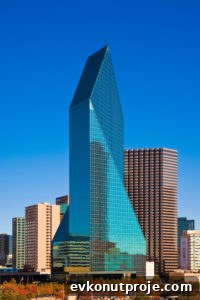
DALLAS – After more than three decades, one of Dallas’s most recognizable buildings is being reimagined, and its transformation offers practical lessons for commercial property owners and developers across Texas.
Atlanta-based Goddard Investment Group is investing $70 million to renovate Fountain Place, the 60-story, 1.2 million-square-foot tower known for its distinctive green-glass, rocket-like silhouette. Designed by Harry Cobb of the I.M. Pei firm and completed in 1986, the building—originally called Allied Bank Tower—sits on Ross Avenue in the Arts District corridor of downtown Dallas.
Goddard, which acquired Fountain Place in 2014, has already begun substantial renovations. Plans include a dramatic lobby overhaul, removal of the mezzanine to create a vaulted 30-foot ceiling, and construction of a new 10-story parking garage with four plaza-level restaurants at the base. Adjacent to the tower, AMLI Residential is developing a 45-story luxury multifamily high-rise. The new garage is scheduled to open in October, and the residential tower is expected to open in 2019.
“While many Dallas buildings of a similar vintage receive only cosmetic upgrades, Fountain Place is being completely reinvented as a vibrant live-work-play destination,” says Johnny Johnson, Executive Managing Director at Cushman & Wakefield, who oversees office leasing along with Lauren Napper. “Success here comes from taking an iconic property and adapting it to meet today’s tenant needs.”
The updated lobby will include a floor-to-ceiling glass art installation custom designed by glass artist Jamie Carpenter, developed in collaboration with Gensler’s Austin office.
Several major tenants have already renewed leases at Fountain Place, totaling more than 500,000 square feet: Tenet Healthcare (240,000 square feet), Wells Fargo (123,650 square feet), Hunton & Williams (87,800 square feet), Bracewell LLP (40,000 square feet) and Gerald Ray (11,500 square feet).
According to Johnson, the project underscores an important market divide: superficial, purely cosmetic upgrades rarely attract new tenants, drive higher rents, or differentiate a property. By contrast, owners who make significant investments to reinvent their buildings can better stabilize existing tenants, increase lease rates, and compete for new tenants.
“Large tenants make long-term choices,” Johnson adds. “They need to trust ownership’s commitment to delivering a superior workplace experience. With low unemployment and fierce competition for talent, attracting and retaining top employees is a critical factor in lease decisions.”
Fountain Place is currently about 85 percent occupied, with roughly 155,000 square feet available. In 2019 an additional 295,000 square feet will become available when the Environmental Protection Agency relocates; the EPA is moving closer to the city core with a 229,000-square-foot lease at Renaissance Tower.
Johnson notes that the on-site multifamily development will elevate the property’s appeal: “Adding residential units creates a true live-work-play environment and sets Fountain Place apart with high-quality amenities and services. The increased pedestrian activity will energize both the site and the surrounding area.”
May 31, 2017 Realty News Report Copyright 2017