
HOUSTON – Hurricane Harvey did not derail Houston’s economic recovery; it only delayed the rebound by a few months, says a leading Texas economist.
“Hurricane Harvey had little impact on Houston’s business structure,” said Patrick Jankowski, CCR, senior vice president of research and regional economist for the Greater Houston Partnership. “Harvey hit the recovery reset button, not the rewind button.”
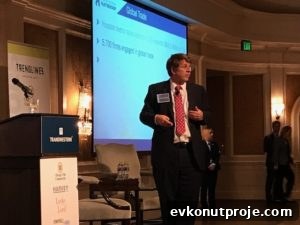
Addressing a standing-room-only audience Thursday night at TrendLines Houston 2017, an invitation-only event at the River Oaks Country Club hosted by Transwestern, Jankowski described the city’s real estate picture. He said the office market is the weakest of Houston’s real estate sectors but is improving, and he expects it to hit bottom next year. “We’ve seen four consecutive quarters of negative absorption. We’re not going to see significant absorption in office space until we see significant job growth,” he explained.
Retail and industrial sectors are performing best, though retail sales remain subdued. “Industrial is one of our strongest markets, absorbing about 2 million square feet per quarter,” Jankowski said. “There are many announcements for new industrial projects. Increasingly, Houston is emerging as a logistics center for commercial products, not just for energy-related goods.”
Jankowski identified three main drivers of Houston’s economy: U.S. economic growth, global trade and energy.
“Houston is part of the U.S. economy,” he noted. “When the U.S. does well, Houston does well. The U.S. has recorded solid growth—about 2.4 percent over the past six quarters. The nation buys what we produce; even when it comes to industrial machinery, some components originate in Houston.”
Global trade plays a significant role as well. “Houston is the second-largest exporter of goods overseas, with $84.1 billion in exports in 2016, behind only New York. We have roughly 5,700 firms engaged in global trade, from companies producing transaction software to engineering firms designing gas plants abroad. Global trade supports between 350,000 and 450,000 jobs here—about one in seven jobs in Houston. As the U.S. economy strengthens, that benefits our region.”
The energy sector remains challenged, with West Texas Intermediate crude trading around $50 per barrel for much of the period, though it has risen above $57 recently. “We’re not going to see a significant amount of hiring or a substantial increase in office leasing until more energy jobs return,” Jankowski added.
Houston’s job growth turned slightly negative in June, July and August of last year, and the city reached the trough of that downturn in the third quarter. “We were seeing growth, then Hurricane Harvey hit,” he said.
Jankowski compared Harvey to Hurricane Ike, saying Ike caused more disruption for Houston’s business community in 2008, while Harvey had a greater impact on families and consumers. “Harvey had little impact on business structure,” he said.
Estimates of Harvey’s damage have been revised downward since the storm. Jankowski noted Moody’s Analytics reduced its estimate from $107 billion to $73.5 billion. He also cautioned against early inaccurate figures: for example, initial claims that 100,000 apartments were destroyed were later shown to be exaggerated—about 16,000 apartments were destroyed, roughly 2.4 percent of Houston’s apartment stock. Of approximately 162,000 homes reporting damage, around 100,000 had significant damage. In total, about 7 percent of all Houston homes experienced some damage.
Jankowski added that roughly 9.6 percent of Houston’s vehicles were damaged in the storm. “But if we lost so many cars, why is traffic still so bad?” he quipped.
Despite the storm, Houston is on track for a record year in single-family home sales, he said.
Jankowski expressed confidence about Houston’s future and used the 2017 World Series champion Houston Astros as an example of the region’s strengths. “Think about this,” he told attendees. “The team’s best player was from Venezuela; a top pitcher moved from Detroit; one of our key catchers grew up in a small Texas town. The Astros’ manager, a Stanford graduate, brought strategy and intelligence to the team. They combined diverse skills to achieve shared success. That’s the spirit of Houston. I’m not worried about the future of this region.”